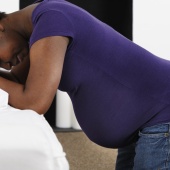
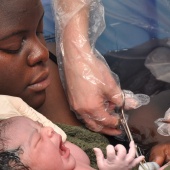
Giving birth is generally very safe for mothers and birthing people who are at a low risk of complications. This is the same if it is a first, second, third or subsequent baby (NICE, 2023).
Most pregnancies are straightforward, and many births could take place without needing medical intervention (Olsen et al, 2012).
Usually hospital trusts have a home birth team or community midwives who will attend women and birthing people at home, so ask the midwife about this.
All women and birthing parents at low risk of complications may choose any birth setting, and they should be supported in this choice (NICE, 2023).
What are the benefits and drawbacks of birth at home?
Advantages of home birth
Women who choose home birth describe it as empowering as they are able to (Chauncy et al, 2025; Zielinkski et al, 2015):
- Control their environment
- Give birth on their own terms
- Control who is present, which might include older siblings and other family members
- Have a greater sense of decision making
- Feel freer to move around and express themselves in the privacy of their home
Disadvantages of home birth
However, the drawbacks are that:
- There is no access to epidural without transfer to hospital
- While the midwife is trained to manage most situations, transfer to hospital may be needed in some circumstances
What pain management is available at home?
The midwife will have the same equipment available to them as they’d have in a midwife-led unit (MLU). All forms of pain management except epidural are possible.
Some Trusts may not offer pethidine at home, so ask the midwife what is offered.
Pregnant women or birthing parents often choose to hire a birth pool for a home birth.
What happens if you need to transfer?
During a home birth, some women decide to transfer to a hospital. Various individual factors may impact the likelihood of transferring from home to hospital. These include (Hollowell et al, 2015b; Hollowell et al, 2015c):
- if the mother has any pre-existing health issues
- if this is a first baby (women and birthing parents having their first baby are more likely to transfer than those who have given birth before)
- if they are experiencing complications (eg meconium in the amniotic fluid)
Most transfers happen during labour and before the baby is born (Blix et al, 2014).
What are the reasons for transfer?
Most transfers are not an emergency, but a precaution. The woman or birthing parent transfers to hospital for further assessment, so they are in the best place for further care if it is needed.
- The main reason for transferring to a hospital is because labour progress is slow and the mother or birthing parent is getting tired, accounting for just over 32 in 100 of all transfers (NICE, 2023).
- Concerns around the baby’s heart rate during labour accounted for 7 in 100 of all transfers (NICE, 2023).
- The labouring woman or person requesting an epidural accounted for 5 in 100 of all transfers (NICE, 2023).
Birthplace in England showed that the average time from the decision to transfer to assessment in the hospital was 49 minutes for homebirths. If there was a potentially urgent reason, the average transfer time was 7-10 minutes less (Hollowell et al, 2015c).
The study showed that transfers from home tended to take less time to arrange and had a shorter travel time than from a free-standing midwifery unit (Hollowell et al, 2015c).
After the baby is born, reasons to be transferred include (NICE, 2023):
- repair to a complicated perineal tear that can't be done at home
- retained placenta
- concerns about the baby’s wellbeing
Safety considerations for first time and subsequent births
For women and birthing parents who have given birth vaginally before, it is as safe for the baby to be born at home as it is in hospital (NICE, 2023). Some with more complicated pregnancies still choose home birth. However, in some specific situations home birth is not recommended.
The Birthplace in England cohort study followed the experience of a very large group of women and birthing people (Brocklehurst et al, 2011). Although it dates from 2011 it remains the most useful information we have on place of birth in England. It is used in the NICE Guideline.
For those who had given birth before and whose pregnancies were considered ‘low risk’ it showed (Brocklehurst et al, 2011; NICE, 2023):
- There was no difference in safety for the baby between planned home birth and planned hospital birth.
- Planning a homebirth significantly reduced the chance of having an unplanned caesarean birth, vaginal birth with forceps or ventouse, or an episiotomy (cut in the perineum).
- Just over one in 10 left home to get care in hospital.
However for a first baby, the same study found that for women and birthing parents (Brocklehurst et al; NICE, 2023):
- There was a slightly increased chance of an unfavourable outcome for the baby.
- There were 9.3 unfavourable outcomes for the baby per 1000 planned homebirths, compared to 5.3 per 1000 for a planned hospital birth. This difference was significant.
- The transfer from home to hospital for women was 44 in 100. This was a higher rate of transfer compared to planning a birth at a midwifery led unit.
A follow-up analysis found that all ages of low-risk women having a first birth had a higher chance of birth without intervention at home than in an obstetric unit. This higher chance decreased as women got older, with those over 40 having the smallest increased chance of vaginal birth at home (Hollowell et al, 2015a).
Planning a home birth was associated with a lower chance of unplanned caesarean birth, regardless of ethnicity (Hollowell et al, 2015).
'High-risk' pregnancies
Those at ‘higher risk’ (who had a pre-existing medical condition) were more likely to transfer to hospital from a home birth, even when they'd had a baby before (Hollowell et al, 2015b).
However, even if the pregnancy is more complicated, a positive outcome was more likely when planning a home birth rather than a hospital birth (Hollowell et al, 2015b).
Babies of women who had ‘higher risk’ factors were more likely to be admitted to neonatal care if planning a hospital birth, rather than a home birth. However researchers couldn't say if this reflected real health differences, or because neonatal care is easier to access from hospital than home (Li et al, 2015).
What might you need at a home birth?
Some hospital trusts have birthing pools which can be borrowed. If not, it’s possible to buy or hire a birthing pool to use at home. The midwife will bring all the other equipment needed for a home birth.
Even though the birth is planned to take place at home, our hospital bag checklist article has ideas of items that can be useful to have to hand during the birth.
These could be packed into a bag in case of a transfer to hospital.
Also useful are:
- A directable light source
- Protection for upholstery (eg sofas, beds)
Birth partner support
Being able to have family members or friends around them during the birth is a positive for many women and birthing parents.
Birth partners report enjoying being in their own home and feel calmer, less anxious and more in control as labour progresses, rather than being in a hospital environment.
If there are other children at home, there will need to be someone there as well as the birth partner to look after them. While some children might want to be present at the birth, others may not.
How do I choose a home birth?
To find out more about a home birth:
- Contact your midwife and ask them about a home birth
- At any antenatal appointment you can tell the midwife you want a home birth.
If a home birth has been planned, it is possible to change to a midwife-led unit (MLU) or hospital birth at any point before or during labour. Similarly, if a hospital or MLU birth has been planned, it is possible to change to a home birth.
The Trust may say they are unable to guarantee a home birth as they do not have adequate staff. Some women and birthing people choose independent midwifery care as an alternative. AIMS and Birthrights provide guidance on rights around home birth.
What is Freebirth?
Unassisted birth, or freebirth, are terms for a birth which is planned without support from health professionals. This is not the same as a birth which proceeds quickly and the baby is born before health professionals arrive (Birthrights, 2024).
These parents may or may not use healthcare throughout pregnancy.
The nature of unassisted birth means it usually takes place at home. Some people choose to birth in a healthcare setting, and ask the healthcare team to remain outside the room until called, but this wouldn’t be called freebirth.
Freebirth is legal in the UK for any adult with the mental capacity to make their own decisions (Birthrights, 2024). It is thought to be on the increase (Higueras et al, 2024).
A doula or partner can provide social support to the labouring woman or person, but it is illegal to provide any medical care (Birthrights, 2024).
Birthrights has more detailed information, including how to register an unassisted birth.
Birthrights (2024) Unassisted birth. https://birthrights.org.uk/factsheets/unassisted-birth/ [23 Oct 25]
Blix, E., Kumle, M., Kjærgaard, H. et al. (2014) Transfer to hospital in planned home births: a systematic review. BMC Pregnancy Childbirth. 14, 179. https://doi.org/10.1186/1471-2393-14-179
Brocklehurst P. et al (2011) Perinatal and maternal outcomes by planned place of birth for healthy women with low risk pregnancies: the Birthplace in England national prospective cohort study. BMJ. 343:d7400. https://doi.org/10.1136/bmj.d7400
Chauncy C, Dawson K, Bayes S (2025) What do safety and risk mean to women who choose to birth at home? A systematic review, Midwifery, 144, 104340. https://doi.org/10.1016/j.midw.2025.104340
Higueras MV, Douglas F, Kennedy C (2024) Exploring women's motivations to freebirth and their experience of maternity care: A systematic qualitative evidence synthesis, Midwifery, 134, 104022. https://doi.org/10.1016/j.midw.2024.104022
Hollowell J, et al. (2015a) The Birthplace in England national prospective cohort study: further analyses to enhance policy and service delivery decision-making for planned place of birth. Chapter 4: The effect of planned place of birth on interventions and maternal outcomes for different groups of ‘low risk’ women. Health Soc Care Deliv Res. 3(36). https://doi.org/10.3310/hsdr03360
Hollowell J, et al. (2015b) The Birthplace in England national prospective cohort study: further analyses to enhance policy and service delivery decision-making for planned place of birth. Chapter 7: The characteristics, management and outcomes of women at ‘higher risk’ of complications planning birth in midwifery units or at home. Health Soc Care Deliv Res. 3(36). https://doi.org/10.3310/hsdr03360
Hollowell J, et al. (2015c) The Birthplace in England national prospective cohort study: further analyses to enhance policy and service delivery decision-making for planned place of birth, Chapter 5: Factors affecting intrapartum transfer and the transfer process. Health Soc Care Deliv Res. 3(36). https://doi.org/10.3310/hsdr03360
Li Y, Townend J, Rowe R, Brocklehurst P, Knight M, Linsell L, Macfarlane A, McCourt C, Newburn M, Marlow N, Pasupathy D, Redshaw M, Sandall J, Silverton L,Hollowell J. (2015) Perinatal and maternal outcomes in planned home and obstetric unit births in women at 'higher risk' of complications: secondary analysis of the Birthplace national prospective cohort study. BJOG. 122(5):741-53. https://www.ncbi.nlm.nih.gov/pubmed/25603762
NICE (2023) Recommendations for planning a place of birth https://www.nice.org.uk/guidance/ng235/chapter/Recommendations#planning…
Olsen O, Clausen JA. (2023) Planned hospital birth compared with planned home birth for pregnant women at low risk of complications. Cochrane Database of Systematic Reviews, Issue 3. Art. No.: CD000352. https://doi.org/10.1002/14651858.CD000352.pub3
Zielinski R, Ackerson K, Kane-Low L. (2015) Planned home birth: benefits, risks, and opportunities. Int J Womens Health. 7:361-377 https://doi.org/10.2147/IJWH.S55561