
Will there be medical staff? Or will it just be you, the neighbour and some hot towels, like in EastEnders? We give you the full (honest) picture…
While you know which medical staff will be around if you have your baby in hospital, who’ll be at a home birth is more unknown.
You might be worried there won’t be enough medically qualified staff around if you have problems. You might worry that having a home birth means going it alone, with just your birth partner for company.
You might wonder what precautions will be taken so that someone can treat you if things don’t go quite according to your birth plan.
Here’s who is likely to be there to support or care for you if you decide to have a home birth.
Partners and birth partners at home births
One advantage of a home birth is that your birth partner can feel they have a bigger role than at a hospital birth (Horn, 2010).
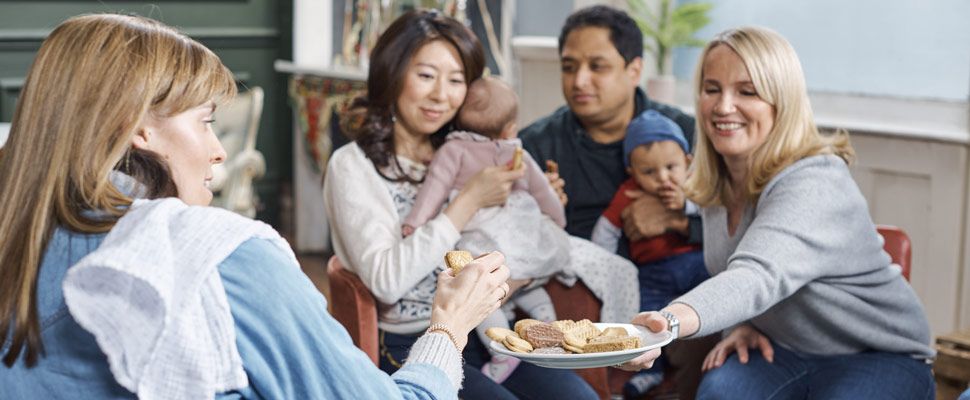
That’s mostly because – usually, and especially if they’re your partner – they know your home well. They’ll know where the spare towels are and, crucially, where you keep the biscuit tin for that urgent sugar boost. Hoorah.
Other friends and family at home births
The nice thing about a home birth is that the line-up of supporting cast members is up to you. You might fancy having other family members and friends there for the big moment, or to distract you during the early stages. If so, you can go for it.
Midwife
Whether you go for an NHS midwife or an independent midwife is your choice. Either way though, your home birth will be supported by a midwife (NHS Choices, 2018).
You might have a second midwife or a maternity support worker who comes along for all or part of your home birth too. That’ll depend on the NHS Trust or your independent midwife and how your pregnancy has been.
Doulas at home births
You might decide to have a doula to support you during your home birth. Doulas are non-medical but function as a constant and supportive presence for you through the whole thing at a home birth.
Most doulas are mums themselves, but they might have done some training too. They’ll listen to exactly what you want and help you understand what’s going on.
If you like the idea of having a doula at your home birth, NCT has a service provided by specially-trained doulas, called NCT Doula. This service provides one-to-one support for parents, including in labour.
Doulas listed on the Doula UK website will have completed a recognised Doula UK course.
Unassisted births or free home births
A few women decide to have their babies without medical support. This is what’s known as an unassisted birth or a free birth.
You might have a number of reasons for doing this, including:
- previous bad experiences of healthcare
- a strong belief in your ability to do it without health professional support. (Feeley and Thomson, 2016)
Bear in mind though that having your baby without a health professional is generally considered risky (Bryan, 2018). So do seek a lot of advice before you make that decision.
This page was last reviewed in October 2018.
Further information
Our support line offers practical and emotional support with feeding your baby and general enquiries for parents, members and volunteers: 0300 330 0700.
We also offer antenatal courses which are a great way to find out more about birth, labour and life with a new baby.
Make friends with other parents-to-be and new parents in your local area for support and friendship by seeing what NCT activities are happening nearby.
Bryan N. (2018) Freebirth data ‘should be collected across UK. Available from: https://www.bbc.co.uk/news/uk-wales-south-east-wales-42706652 [last accessed 9th October 2018].
Feeley C, Thomson G. (2016) Why do some women choose to freebirth in the UK? An interpretative phenomenological study, BMC Pregnancy Childbirth 16:59. Available from: DOI: 10.1186/s12884-016-0847-6 [last accessed 9th October 2018].
Horn A. (2010) Fathers and homebirth. Home Birth Reference Site. Available from: http://www.homebirth.org.uk/blokes.htm [last accessed 9th October 2018].
NHS Choices (2018) Where to give birth: the options. Available from: https://www.nhs.uk/conditions/pregnancy-and-baby/where-can-i-give-birth/ [last accessed 9th October 2018].
Further reading
AIMS. (2016) Booking a home birth. Available from: https://www.aims.org.uk/information/item/booking-a-home-birth [last accessed 5th October 2018].
Brocklehurst P, Hardy P, Hollowell J, Linsell L, Macfarlane A, McCourt C, Marlow N, Miller A, Newburn M, Petrou S, Puddicombe D, Redshaw M, Rowe R, Sandall J, Silverton L, Stewart M. (2011) Perinatal and maternal outcomes by planned place of birth for healthy women with low risk pregnancies: the Birthplace in England national prospective cohort study. BMJ. (343):d7400. Available from: https://doi.org/10.1136/bmj.d7400 [last accessed 9th October 2018].
De Jonge A, Verhoeven C, Thornton J (2014) Perinatal mortality and morbidity up to 28 days after birth among 743 070 low‐risk planned home and hospital births: a cohort study based on three merged national perinatal databases. BJOG. 122(5):720-728. Available from: https://doi.org/10.1111/1471-0528.13084 [last accessed 9th October 2018].
Li Y, Townend J, Rowe R, Knight M, Brocklehurst P, Hollowell J. (2014) The effect of maternal age and planned place of birth on intrapartum outcomes in healthy women with straightforward pregnancies: secondary analysis of the Birthplace national prospective cohort study. BMJ Open 4(1). Available from: https://bmjopen.bmj.com/content/4/1/e004026.long [last accessed 5th October 2018].
NICE. (2014) CG190 Intrapartum care for healthy women and babies. Available from: https://www.nice.org.uk/guidance/cg190/ [last accessed 5th October 2018].
ONS. (2013) Births in England and Wales by characteristics of birth 2. Available from: https://www.ons.gov.uk/peoplepopulationandcommunity/birthsdeathsandmarr… [Last Accessed: 9 October 2018].
ONS. (2016) Birth characteristics in England and Wales. Available from: https://www.ons.gov.uk/peoplepopulationandcommunity/birthsdeathsandmarr…, [last accessed 9th October 2018].
RCM. (2008) Position paper 25 Home birth. Available from: https://www.rcm.org.uk/news-views-and-analysis/analysis/position-paper-… [Last Accessed: 9 October 2018].
RCOG/RCM. (2007) Joint statement No. 2, Home births. Available from: https://www.rcm.org.uk/sites/default/files/home_births_rcog_rcm0607.pdf [last accessed 9th October 2018].
Rowe RE, Townend J, Brocklehurst P, Knight M, Macfarlane A, McCourt C, Newburn M, Redshaw M, Sandall J, Silverton L, Hollowell J. (2013) Duration and urgency of transfer in births planned at home and in freestanding midwifery units in England: secondary analysis of the birthplace national prospective cohort study. BMC Pregnancy and Childbirth. 13(1):224. Available from: https://doi.org/10.1186/1471-2393-13-224 [last accessed 5th October 2018].
Rowe R, Li Y, Knight M, Brocklehurst P, Hollowell J. (2016) Maternal and perinatal outcomes in women planning vaginal birth after caesarean (VBAC) at home in England: secondary analysis of the Birthplace national prospective cohort study. BJOG. 123(7):1123-1132. Available from: doi: 10.1111/1471-0528.13546. [last accessed 9th October 2018].
Singh D, Newburn M. (2000) Access to maternity information and support: the needs and experiences of pregnant women and new mothers. London: NCT. [last accessed 9th October 2018].
Which? Birth Choice. (2018) Home birth checklist. Available from: https://www.which.co.uk/birth-choice/having-a-home-birth/home-birth-che… [last accessed 9th October 2018].