Play and your child's development

Children can learn a lot through play and here we discuss different ways to help you enjoy and get the most from playtime together.

As a parent you can help your child enjoy learning through play. In fact, your child will learn more from you than anyone else and will love playing games and making discoveries with you.

Quality playtime doesn’t need to be expensive: many children love playing with cardboard boxes and wooden spoons from the kitchen, dressing up or simply making dens out of old sheets, and story time and singing are free.

Here we look at different types of play including: active play, discovery play, sensory play, let’s pretend, music and rhythm, art and being together.

Active play

From an early age, babies enjoy physical contact and movement. Discovering their hands and feet allows them to explore using their senses. They learn from physical interaction with you, watching and copying your facial expressions, and reacting to your touch and tickles.

Older babies enjoy more energetic play, such as bouncing on your lap, neck rides and ‘flying’ in the air. As they become more mobile and start to roll, crawl, climb and reach, each of these activities will encourage the development of your baby’s strength and agility.

When your toddler learns to walk, they often gain confidence from a push-along walker. In addition by playing with balls, bats, trikes and scooters they practise their balance and their hand-eye co-ordination.

Physical play improves motor skills, keeping children fit and active.

Discovery play

Young babies are fascinated by contrasting shapes and colours and will use their mouths to investigate different objects in their grasp. Enabling your baby to explore different, safe objects is key to helping their development.

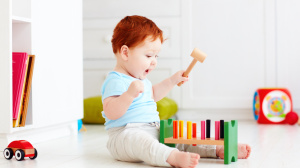
A box with wooden spoons, different sized pots, cotton reels on string and bits of textured materials may prove to be a useful and fun discovery tool for your baby. As your baby grows into a toddler, she will gradually develop finer motor skills and will be able to handle and explore objects with more dexterity. Along with noticing similarities between objects she will also notice differences as well as experience the concepts of shape, size and colour.

Ideal items to play with at this stage include shape sorters, bowls and wooden spoons, simple jigsaws, stacking toys, plastic cups, matching (can you find the other apple?) and grouping (can you find all the blue cars?). This sort of play provides babies and toddlers with hands-on experiences with real life materials that will help them understand mathematical and scientific concepts in the future.

You can also use this type of play to help them develop their understanding of the physical relation of objects that are in, under, behind or on top of each other.

Sensory play

Babies and toddlers are fascinated by their home and the world outside. Young babies enjoy lying outside underneath a tree, feeling the wind on their faces and watching the tree branches move. Some older babies will love to sit on the grass and feel different textures.

Exploring natural materials such as wood, sand, water, stones are all part of your baby’s and toddler’s growing experiences of the world. This type of play stimulates their sense of touch and sound. It is here they begin to notice the different feel of things – wet, sticky, muddy – and hear how things make different sounds, the ‘whoosh’ noise of water, and clunk of pebbles, for instance.

Let’s pretend

Kids love make-believe play. It encourages them to mimic their own personal experiences and begin to learn how to cope with the real world. Babies will start by copying your facial expressions and will later copy actions such as clapping. Toddlers begin to copy simply by helping you do your daily tasks: shopping, loading and unloading the washing machine or digging in the garden.

Make believe fantasy play usually occurs when toddlers begin to talk. Many children enjoy playing with tea sets, dolls and teddies, pretend shopping, making dens or dressing up. This allows them to play and learn from each other, building their social and emotional skills. Children who pretend, dress up and experiment with different situations learn to co-operate, build relationships with others and develop more empathy.

Another great way to get your toddler involved is in cooking or preparing food, as this helps them understand textures and tastes of foods, as well as what's involved in preparing a meal. This could include mixing, stirring or podding peas, for example, rather than any kind of chopping, of course!

Music and rhythm

From very early on babies enjoy gentle music and simple songs. Older babies love action songs and rhymes with stronger beats and rhythms. Singing provides an ideal way for you to play with your baby or toddler and also helps build a good relationship between baby and parent.

From about six months, babies will enjoy the social interaction of action songs and will learn to anticipate the actions and develop co-ordination skills as they master them. Toddlers will enjoy making music with a variety of simple and homemade instruments to shake and bang.

Art

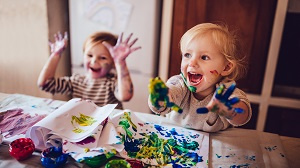
Children who indulge in messy play are stimulating their imagination, learning creative and manipulative skills, developing hand-eye co-ordination and building their concentration.

'Play-dough' (either bought or home-made) is another useful and cheap material and can be great in indulging your child's artistic side.

Every child will play at their own pace, exploring new textures and forming new concepts about colour, shape and size. Children will enjoy learning how to hold, move, fold, paint, glue or stir and it is this process that is just as important as the end goal.

Being together

By fitting in some special quality time when you can actually get down to your child's level and play a game with them, you will find that both of you will benefit and have fun too.

Further information

NCT's helpline offers practical and emotional support in all areas of pregnancy, birth and early parenthood: 0300 330 0700.

You might find attending one of NCT's Early Days groups helpful as they give you the opportunity to explore different approaches to important parenting issues with a qualified group leader and other new parents in your area.

Make friends with other parents-to-be and new parents in your local area by seeing what NCT activities are happening nearby such as the Cheeky Monkey Tea Parties.

For a range of books and teaching aids concerning communicating with babies please visit www.nctshop.co.uk.

Words for Life, a dedicated website from the National Literacy Trust, provides clear information about early communication skills and is a great resource for ideas on bringing these skills into your baby’s everyday life.

NHS Choices provides a guide to Learning and Playing with your child in its early years.

Playday organises the National day for play and has information on events nation wide.

Post a comment

Login or register to post comments