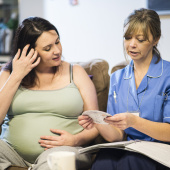
What are maternity notes or the maternity notes folder?
Maternity notes can either be (Birthrights, 2021; NHS, 2023):
- a paper book/folder, and called ‘handheld notes’ or ‘handheld records’
- electronic notes, and called ‘digital care records’
They are given to the mother or birthing person at the booking appointment, or it will be explained how to access them digitally (Birthrights, 2021; NHS, 2023). It is possible to decline digital notes and ask for paper notes.
The notes are needed at every antenatal appointment or any other healthcare appointment during pregnancy. In them, the midwife records each appointment, test or scan. The notes also record the care received during labour and birth, and the early postnatal period (Birthrights, 2021).
The mother or birthing person can ask the maternity team to explain anything recorded in the notes (NHS, 2023). They can also keep their own notes about what was discussed at antenatal appointments, during labour, and after the birth.
When to take them with you
The NHS advises the mother or birthing person to take maternity notes with them when they are away from home. This is important in case medical support is needed (NHS, 2023).
What’s in the maternity notes
Maternity notes contain information about the mother or birthing person:
- Contact details
- Medical history and any family history that might be relevant to the pregnancy
- Information about any previous pregnancies and births
They also contain:
- Appointment times
- Phone numbers for the midwife and labour ward
- Information gathered at antenatal checks, plus any blood tests, investigations, and ultrasound scans. This includes assessment of the baby’s growth and any problems encountered during pregnancy.
- Birth plan
- Labour care
- Postnatal care
- Leaflets and extra information
Common abbreviations used in maternity notes
The notes record information and details of any routine checks that the mother or birthing person has consented to or declined. Abbreviations are used in maternity notes – here are some common examples:
- Urine test results (for presence of protein or sugar which might indicate pre-eclampsia or diabetes)
NAD / Nil: nothing abnormal detected / none found
Tr (trace): small amount of sugar or protein found
+ , ++ , +++: presence of greater amount - The baby’s heartbeat or activity – measured by listening to the baby and feeling the mother or birthing person’s belly
FHH: foetal heart heard (i.e. the baby’s heart is audible)
FHHR: foetal heart heard and regular
FHNH: foetal heart not heard
FMF: foetal movements felt
By feeling the belly (with consent), the midwife will record:
- Position of the baby – the way they are lying in the womb
L: longitudinal (upright within the mother or birthing person’s body)
O: oblique (slanting)
T: transverse (sideways) - Which part the baby presents towards the birth canal
C: cephalic (head down– also called vertex)
B or Br: bottom first or breech - Which side of the mother or birthing person’s body the baby is lying on
L or R for left or right - Which part of the baby is presenting at the cervix
O for occiput (head)
S for sacrum (bottom) - Where the presenting part is
A: anterior (to the woman or birthing person’s belly)
P: posterior (to the back)
L: lateral (to the side) - Engagement of baby’s head in the pelvis is recorded as
NE - not engaged
E - engaged - Or it may be recorded in fifths of what the midwife can feel, e.g.:
4/5 = can feel most of the head above the pelvic brim
2/5 = most of the baby’s head has moved into the pelvis
Engagement is likely to happen earlier in a first pregnancy. It is information for the midwife but doesn’t indicate when the baby will be born.
What happens to maternity notes after the birth?
Maternity records are held by the NHS Trust or Board for 25 years after the birth (Birthrights, 2021).
If private care was used, the care provider will keep the notes. The mother or birthing person will probably be offered a copy (Birthrights, 2021).
Getting access to the notes
The mother or birthing person might simply be interested in seeing their notes, or might want to understand decisions made during the birth. Some wish to confirm facts to make a complaint.
Everyone has the right to see their own health records under the Data Protection Act 2018 and under Article 8 of the European Convention on Human Rights (Birthrights, 2021).
Viewing the record can be done in person at the place where they are held, for example at the hospital. The GP, midwife or health visitor can help with getting access (Birthrights, 2021).
If you want a copy, then it may help to be clear about what you want to see. For example, if it’s just the notes of labour rather than the entire maternity record, a midwife may be able to provide a quick copy. If the entire medical record for the pregnancy is wanted, then this is a large job as every scan and test will need to be copied.
A written ‘subject access request’ for the full notes can be made to the NHS Trust’s medical records manager for maternity records. The address should be available on the website of the NHS Trust or Board (Birthrights, 2021).
How long will it take?
The subject access request must be processed within 40 days (Birthrights, 2021).
How much does it cost?
You normally wouldn't need to pay to see the records.
Birth reflections services
The local hospital may offer a ‘Birth reflections’ or ‘Birth Afterthoughts’ service where you can talk about the notes with a healthcare professional. The Patients Advice and Liaison Service (PALS) team or the midwife will be able to advise if this service is available locally (Birthrights, 2021). Details of the PALS team should be on the 'Contact Us' section of the NHS Trust or Board website.
When accessing the Birth reflections service, it’s a good idea to have someone else go along with the mother or birthing person for support.
Birthrights (2021) Your right to see your maternity records. https://birthrights.org.uk/factsheets/accessing-your-records/ [28 Oct 25]
NHS (2023) Your antenatal care. https://www.nhs.uk/pregnancy/your-pregnancy-care/your-antenatal-care/ [28 Oct 25]