- Home
- Pregnancy
Pregnancy topics
years NCT has been campaigning as the voice for parents on the issues they care about
- Birth
Stages
Birth topics
branches across the UK run thousands of events all year round
- Parenting
Parenting topics
NCT practitioners support parents to find information they need to prepare for their new life
- In your area
Parenting topics
NCT practitioners support parents to find information they need to prepare for their new life
- Courses
Parenting topics
NCT practitioners support parents to find information they need to prepare for their new life
Pregnancy tip
Walking is a great way to improve aerobic fitness and help tone your legs.
Good exercise for pregnancy
Here we provide information on exercising during pregnancy including which sports to avoid, low-impact exercise, pelvic floor, and safety issues.
This article covers the following topics:
Cardio exercise in pregnancy
Walking
Running
Swimming
Weight training in pregnancy
Tummy and pelvic floor exercises
Pilates and yoga in pregnancy
Further information
Exercise during pregnancy is important for your health and that of your baby. But what sorts of excercise are best when you are pregnant, and are there any types you should avoid?
Cardio exercise in pregnancy
Cardiovascular exercise is activity such as walking or swimming which raises the heart rate. It will benefit both you and your baby as it:
- improves your efficiency in transporting and utilising oxygen,
- reduces the likelihood of developing circulatory problems, such as cramps or varicose veins,
- improves blood flow to the placenta and
- reduces the risks of gestational diabetes and high blood pressure.
Cardiovascular exercise also increases your energy levels, can improve your sleep patterns and, importantly for many women, can control additional weight gain.
Walking
Walking is a great way to improve aerobic fitness and help tone your legs. It is easy to incorporate into your day - get off the bus one stop earlier, park the car further away, or take the stairs rather than the lift – just walk!
Your ankles are more vulnerable to twisting during pregnancy so make sure you have the correct footwear for the terrain you’re walking on. Flat shoes for work will help you incorporate walking into your daily routine. If walking n the country use walking boots or waterproof trainers, as wellies do not provide sufficient ankle support.
A good heel/toe action is essential to absorb shock through the foot, and try to keep the legs aligned in front rather than turning out. Walk tall with shoulders down and head up and don’t forget to use your abdominal muscles to draw your baby in.
A good supportive bra is important to reduce breast movement, particularly if you’re walking briskly. As your pregnancy progresses, you will naturally reduce the pace to maintain comfort.
Running
It’s not a good idea to continue running beyond around 20 weeks due to increased impact on the joints, breasts and pelvic floor during pregnancy, as well as increased movement of the abdomen.
Swimming
Exercising in water supports your bump and is great for your circulation as the pressure of the water on your blood vessels stimulates blood flow and reduces any swelling. It’s also an excellent way to maintain your abdominal tone. Take care not to overwork these muscles with strong rotational movements, particularly in deeper water.
Gentle swimming can be particularly relaxing but if you are experiencing any pelvic girdle pain you should avoid breaststroke leg action. Avoid butterfly stroke as this encourages large spinal movements. Invest in a pair of goggles so you can swim with your head down – swimming with your head lifted out of the water will cause your hips to drop and accentuate the increased curve in the lumbar spine.
You don’t have to be a swimmer to enjoy the benefits of water – contact your local pool to find out about water exercise classes for pregnant women.
Weight training in pregnancy
As pregnancy progresses, your body undergoes its own weight training. Your legs will naturally strengthen with the increased weight and your spinal muscles will tighten to keep your body upright.
Your arms, however, may not be similarly challenged, especially if your partner insists you don’t do any lifting. Yet as soon as your baby arrives, you will be required to lift, carry and hold her for many hours and even a little seven pound baby will start to feel heavy! So do lift the lighter shopping bags and politely decline the offer of a hand up from the sofa so that your arms get some work, but ensure you do so with the abdominal muscles held in.
Tummy and pelvic floor exercises
The abdominal (stomach) muscles undergo an enormous amount of stretching during pregnancy, weakening your spinal support mechanism and causing low back pain. It is vital that these muscles are used when bending, lifting and carrying; they should also be activated regularly throughout the day to help maintain a degree of abdominal tone. This will also help you regain a flat tummy postnatally. Sit ups should not be performed after the first three months as this will stress the muscles further and delay postnatal repair.
This exercise can be done in any position – sitting, standing or kneeling on hands/knees.
- Draw your tummy in towards your spine
- Hold for a few seconds, continuing to breathe
- Release gently
- Repeat as frequently as possible throughout the day
- Incorporate this when you bend or lift to keep your back supported
- This should be a soft sinking feeling, rather than a strong bracing action and the breath should not be held.
It is also essential to exercise the pelvic floor muscles regularly.
Pilates and yoga in pregnancy
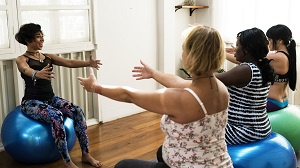
Pregnancy is the perfect time to get in touch with your body and there’s no better way to do so than with a mind/body workout such as Pilates or yoga. Check the instructor is qualified to teach pregnant women or, better still, attend a pregnancy-specific class. If you do yoga or pilates at home, make sure the exercises you do are safe for pregnancy.
Such classes aim to improve posture through stretching and strengthening exercises which should help to reduce pregnancy aches and pains. However, do be careful not to overstretch.
Pilates is particularly good for strengthening the deep abdominal and pelvic floor muscles. Yoga and meditation may help you to relax – deep breathing and relaxation techniques are essential tools to help you de-stress and will be invaluable during labour.
If you prefer a gentler mind/body exercise, you may find yoga breathing and relaxation exercises very helpful – and this will also help prepare you for labour.
Further information
NCT's helpline offers practical and emotional support in all areas of pregnancy, birth and early parenthood: 0300 330 0700. We also offer antenatal courses which are a great way to find out more about birth, labour and life with a new baby.
The NHS has a site on pregnancy and exercise including tips and suggested excercises.
The Royal College of Obstetricians and Gynaecologists have guidlelines on recreational excercise and pregnancy.
For books and dvds suitable for use during pregnancy please visit NCT shop.


Post a comment