What will I need?
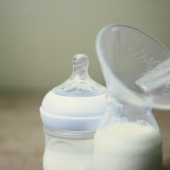
Buy any kit you need in advance, including (NHS Start for Life, no date a):
- bottles
- teats
- bottle brushes
- sterilising equipment
- breast pump (if planning to express milk)
- first infant formula milk powder or ready-to-feed liquid formula
There are many different types of bottle and teats for sale. It may take a while to try a couple of different ones to see what works best for you and your baby.
Getting ready to feed
It can take a little while to make up a feed, so it can be useful to start preparing a bottle when the baby shows the first signs of hunger.
Always follow good hygiene practices, like washing your hands, before preparing a feed. Bottles and teats need to be washed thoroughly and sterilised before each use (NHS, 2023).
You can read more about expressing breastmilk for a feed.
When making up powdered infant formula, it is very important to follow guidelines on how to make up a feed. Ensure the water is at the correct temperature as formula powder is not sterile. This will reduce the likelihood of the baby picking up an illness or infection.
What is responsive feeding?
When it comes to feeding or breastfeeding, all health professionals recommend ‘responsive feeding.’ This means learning to recognise the early signs that your baby is hungry (often called feeding cues) and never forcing them to finish a feed if they’ve had enough (NHS Start for Life, no date b).
Feeding your baby responsively helps you bond with your baby and makes them feel loved. Try talking to them gently and look into their eyes to reassure them during feeds. This helps them to feel safe and secure (UNICEF, 2016).
Focusing on your baby while you’re feeding them also helps to pick up their feeding cues. There is some research that shows that being distracted when feeding, for example by looking at mobile devices, can lead to overfeeding (Golen &Ventura, 2015).
How often should I feed my baby?
As a general rule, babies should feed at least 8-12 times a day. Our article: 'Is my baby feeding well?' explains how often you should feed your baby and how to tell they're getting enough milk.
How do I know when my baby is hungry?
Your baby’s early feeding cues can include movements like (NHS Start for Life, no date b; UNICEF, 2016):
- sticking their tongue out
- putting their hands to their mouth
- starting to get restless
- opening their mouth and turning their head to the side
- sucking on their fists or fingers
Crying is usually a late sign of hunger. If you wait until your baby starts crying for milk, you might find it harder to settle them for a feed (NHS Start for Life, no date a; UNICEF, 2016). If your baby is upset, try to soothe them before you offer a feed. Skin-to-skin contact is a great way to calm babies.
How do I bottle-feed my baby?
Find somewhere comfy to sit and hold your baby close to you. They should be fairly upright, with their head supported, so they can breathe and swallow comfortably (UNICEF, 2016).
Hold them steady and rub or pat their back to bring up any wind (UNICEF, 2016). Babies should never be fed with a propped-up bottle, as they could choke on the milk (First Steps Nutrition Trust, 2021; NHS Start for Life, no date a).
Tips for bottle-feeding (UNICEF, 2016; NHS, 2024):
- Feed responsively rather than to a schedule.
- Watch out for your baby’s hunger cues.
- Hold your baby in an upright position, with their head supported, close to the parent’s body.
- Touch the teat against the baby’s top lip, encourage them to open their mouth and pull the teat into the mouth.
- Keep the bottle in a horizontal position (not tipped above your baby where the weight of the milk could force them to drink too quickly).
- Support pauses in drinking. When your baby pauses, tilt the bottle downwards so the milk stops flowing from the teat. They may need to burp in the pauses.
- Short breaks allow babies to register fullness, so they can regulate the amount of milk they drink.
- If your baby is showing hunger cues, offer the bottle again.
- Don't force your baby to take the bottle or finish the bottle if they don’t want to.
- Follow your baby’s lead on how much they want to drink, rather than going by how much is in the bottle.
- Signs the baby has had enough milk are if they seem happy and relaxed, and move away from the bottle.
Who should bottle feed my baby?
Babies build up trust and confidence during feeding, gradually learning what to expect. This is partly how they develop healthy emotional and social attachment.
In the early weeks and months, it might help to keep most of the baby’s bottle-feeds to parents, or one other trusted person (UNICEF, 2016).
If someone else is bottle feeding your baby, talk to them about how to feed the baby so there’s some consistency (UNICEF, 2016).
How much milk should I give them?
Babies can be trusted to feed according to their appetite, so be guided by them. In the early weeks, babies might be unpredictable, and their needs may change day by day.
Newborn babies generally take quite small amounts of formula in frequent intervals to start with (First Steps Nutrition Trust, 2021).
A formula fed baby will need to be fed according to the guidelines for their weight and age.
As a general rule, by the end of the first week most babies will require approximately 150ml to 200ml per kilogram of body weight per day, until they’re six months old. For example, a baby weighing 6kg at the end of four months, would approximately need 900ml to 1200ml of infant formula per day (First Steps Nutrition Trust, 2021).
The daily volume is likely to be taken in different-sized portions throughout the day, meaning for instance that one feed could be 60ml, and another 150ml.
Following responsive feeding will mean this will vary, so use these amounts as a rough guide whilst following what the needs of your own baby are.
Babies are likely to need night feeds for the first year of life, 70% of 6-18 month olds wake up at least once per night (Hysing et al, 2014).
What if my baby refuses the bottle, or is fussy with bottle feeding?
If the baby doesn’t seem to want more milk after the first 20ml to 30ml, then they may need a break at this point (see the information about responsive feeding above). If they’re not interested, they may just need to feed little and often – this is normal for some babies.
Different teats can affect how well a baby feeds from a bottle. It can be worth trying a selection of teats to see if there is one the baby prefers.
If this doesn’t help, or the baby is often fussy or fights the bottle, ask the health visitor to watch you feed them, as they might have some suggestions.
Bottle-feeding tips for breastfed babies
If the baby has been breastfed so far, they may be reluctant to take a bottle at first. It might help if:
- Someone apart from the mother or breastfeeding parent offers them a bottle if they find this confusing.
- The baby is held in a different position from the normal breastfeeding one.
- They are offered a bottle when they're not particularly hungry. When a breastfed baby is hungry, they are thinking about the breast, so might get agitated if offered a bottle until they learn that this is also food.
- Different teats are tried.
- Some breastfed babies never drink from a bottle, but move straight onto a sippy cup.
How do I know if my baby is getting enough milk?
There are certain signs that will tell you if a baby is getting enough milk. For example, their weight gain and number of wet and soiled nappies. Generally, a baby should be producing around six wet nappies and at least one soft poo from a few days after birth (NHS Start for Life, no date c).
What sort of bottles and teats should I use?
You can use whichever bottles and teats you and your baby prefer. Yet the use of larger bottles (more than 6oz) has been associated with increased formula intake among two month old babies, leading to a risk of overfeeding (Wood et al, 2016).
Some teats are more suited to paced bottle feeding. Choose teats that fill with milk when the bottle is held in a horizontal position, as some need the bottle to be tipped upside down to fill the teat. These are less suited to responsive feeding (UNICEF, 2016).
You can buy teats with different sized holes that vary the flow depending on your baby’s age and ability to suck and swallow. It is important to replace bottles and teats when they look worn, as this makes it hard to keep them clean. Worn teats can also disintegrate and split.
When do babies start eating solid food?
Babies start eating solid food from about six months – this leads to a gradual reduction in the amount of milk they need. But milk is still their main food for the first year of life (First Steps Nutrition Trust, 2021). The timing of introducing solid food is different for premature babies.
Read our information about introducing solid foods to your baby.
Support from NCT
We support all parents, however they feed their baby. If you have questions, concerns or need support, find out more about what we offer.
Breastfeeding counsellors have had extensive training, will listen without judging or criticising and will offer relevant information, whether you are exclusively breastfeeding or using formula milk.
First Steps Nutrition Trust (2021) A simple guide to infant formula, follow-on formula and other infant milks. https://www.firststepsnutrition.org/parents-carers/. [Jun 25]
Golen RB, Ventura AK. (2015) Mindless feeding: Is maternal distraction during bottle-feeding associated with overfeeding? Appetite. Aug;91:385-92. https://doi.org/10.1016/j.appet.2015.04.078
Hysing M, Harvey AG, Torgersen L, Ystrom E, Reichborn-Kjennerud T, Sivertsen B. (2014) Trajectories and predictors of nocturnal awakenings and sleep duration in infants. J Dev Behav Pediatr. Jun;35(5):309-16. https://doi.org/10.1097/DBP.0000000000000064
NHS Start for Life (no date a) What you need for formula feeding. https://www.nhs.uk/start-for-life/baby/feeding-your-baby/bottle-feeding/how-to-make-up-a-feed/things-you-need-for-formula-feeding/ [Jun 25]
NHS Start for Life (no date b) Feeding on demand. https://www.nhs.uk/start-for-life/baby/feeding-your-baby/bottle-feeding/bottle-feeding-your-baby/feeding-on-demand/ [Jun 25]
NHS Start for Life (no date c) Bottle feeding your baby. https://www.nhs.uk/start-for-life/baby/feeding-your-baby/bottle-feeding/bottle-feeding-your-baby/ [Jun 25]
NHS. (2023) How to make up baby formula. https://www.nhs.uk/conditions/pregnancy-and-baby/making-up-infant-formula/ [Jun 25]
NHS. (2024) Bottle feeding advice. https://www.nhs.uk/baby/breastfeeding-and-bottle-feeding/bottle-feeding/advice/ [Jun 25]
UNICEF UK. (2016) A guide to infant formula for parents who are bottle feeding. https://www.unicef.org.uk/babyfriendly/wp-content/uploads/sites/2/2016/12/Parents-guide-to-infant-formula.pdf [Jun 25].
Wood CT, Skinner AC, Yin HS, Rothman RL, Sanders LM, Delamater A, Ravanbakht SN, Perrin EM. (2016) Association Between Bottle Size and Formula Intake in 2-Month-Old Infants. Acad Pediatr. Apr;16(3):254-9. https://doi.org/10.1016/j.acap.2015.08.001