Jump to: Feeding a baby away from home
It's really important to follow good hygiene practices, like washing hands and disinfecting the surface, when making up a bottle of formula milk for your baby. A baby’s immune system isn’t as well developed as an adult’s. This makes them more vulnerable to illness and infection, particularly diarrhoea and vomiting (NHS, 2023 a).
Very young babies and babies with low immune systems, like premature babies, are even more vulnerable to bacteria. It’s particularly important to follow these guidelines or consider using sterile ready-made liquid feeds.
Which formula milk should I use?
For the right kind of formula milk to use, look at our page on what kind of formula milk. Babies should be fed on first infant formula milk until 12 months, when they can switch to full fat cow’s milk. All first infant formula milks contain the same ingredients if they are found to support baby development. There’s no need to use follow on formula milks. It’s also fine to change the brand.
It is possible to buy first infant formula milk as a ready-to-feed liquid, which can be a convenient short-term solution. However this works out as more expensive to buy than powdered infant formula milk if used regularly.
You can call our Infant Feeding Line for support every day of the year, from 8am to midnight, on 0300 330 0700.
How to make up a feed
Before you start, make sure all the bottles, teats and lids are washed and sterilised. Read our guide to sterilising baby bottles and teats. Then follow these steps (NHS, 2023 a):
Step 1: Boil fresh water
Using fresh water that hasn’t been boiled before, fill the kettle with at least 1 litre of fresh tap water. Boil the water, then leave to cool for no more than half an hour. The water should still be at the required 70°C at this point.
Step 2: Clean the area and wash your hands
It’s important to disinfect the surface you are going to use and wash your hands thoroughly.
Step 3: Pour the water into the bottle
Pour the amount of water you need into the bottle before you put the powdered formula in. Double check the water level is correct before mixing in the powder.
Step 4: Add the formula milk powder
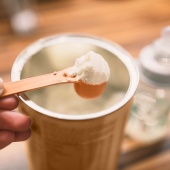
Use the scoop that came with the formula milk powder as different scoops may pick up different amounts. Loosely scoop up the powder according to the manufacturer's instructions.
Level off the spoon with the leveller from the pack or the flat edge of a clean, dry knife.
Step 5: Replace the teat and shake to mix
Screw the teat back on the bottle, holding it by the edge to keep the teat sterile. Cover the teat with the cap and shake the bottle until all of the formula milk powder dissolves.
Step 6: Cool down the formula milk
Make sure the milk is at the correct temperature before giving it to your baby. Hold the bottle (with the lid on) under cold running water until it feels about body temperature (37°C).
Always test the temperature of the formula milk on the inside of your wrist before feeding it to your baby.
Step 7: The formula milk is ready to feed
When the milk is the right temperature, it can be fed to the baby. Read our page on responsive feeding.
Step 8: Throw away leftover formula milk
After feeding your baby, throw away any unused feed within an hour of the start of the feed. This is because the baby’s saliva mixed with the unused formula milk can cause bacteria to grow (CDC, 2024).
Tips for preparing formula milk feeds (NHS, 2023 a)
- The water to make up a feed needs to be boiled freshly each time. This is because the balance of minerals in previously boiled water might not be suitable for making formula milk.
- Formula milk powder isn’t sterile and can contain bacteria. To kill any bacteria, the water temperature needs to be at least 70°C.
- Always follow the manufacturer's instructions carefully. The amount of water and powder to use can differ depending on the brand.
- Too much powder can cause constipation and dehydration, and too little may mean the baby doesn’t get the nourishment they need.
- You shouldn’t add anything else to the bottle like sugar or cereals.
Can I make up more than one feed at a time?
No. Make up each feed when it is needed, because bacteria multiply very quickly at room temperature. Bacteria will still multiply if the feed is kept in a fridge, although this will happen more slowly (NHS, 2023 a).
A feed which is started should be thrown away within an hour. A feed that hasn’t been used and kept at room temperature should be thrown away after two hours if not used (NHS, 2023 a).
Can I use a microwave to heat up a formula milk feed?
Microwaves shouldn’t be used as they can create hot spots, which may burn the baby’s mouth (NHS, 2023 a).
What about using baby kettles, formula milk preparation machines and hot taps?
Baby kettles or formula preparation machines claim to work by keeping water at 70°C. The idea is to save time, especially when making up night feeds.
Baby kettles
However, there is a risk that in baby kettles the water is repeatedly boiled to keep it at this temperature, when fresh water should always be used (First Steps Nutrition Trust, 2019).
If the water is delivered at 70°C, it is also likely to cool below this temperature when poured into the bottle and powder added. So First Steps Nutrition Trust advise caution when using baby kettles (First Steps Nutrition Trust, 2019).
Formula milk preparation machines
Some research has also found that the water delivered by formula milk preparation machines can fall below 70°C. Therefore, the temperature is not hot enough to kill bacteria in the formula milk powder. The Food Standards Agency (FSA) advises checking the temperature of the water used to make up a formula milk feed. This should be done ‘regardless of the method used’ (First Steps Nutrition Trust, 2019).
Hot taps
First Steps Nutrition Trust tried using a hot tap to make up powdered formula milk. They found that the formula milk powder should be added quickly to the water and mixed, to prevent the water cooling below 70°C.
This should be:
- immediately for a feed using 60-90ml water
- within 5 minutes for a feed using 120-180ml water
- within 10 minutes for a feed using 210-240ml water.
First Steps Nutrition Trust found that the safest way of preparing water for a feed is with a normal household kettle (First Steps Nutrition Trust, no date).
How long can you keep infant formula powder?
Infant formula milk powders should be used within one month of opening. Anything left should be thrown away after this. If exclusively formula feeding, the formula is likely to be used up in this time (CDC, 2024). It can be useful to write the date the tin was opened on the lid (CDC, 2024).
Don’t use infant formula milk powder after the use by date (CDC, 2024).
Feeding a baby away from home
Water can be boiled and immediately poured in a clean vacuum flask to mix with formula milk powder when out and about. The flask should be clean and only used for this purpose. Ideally it should also be warmed with boiling water for a minute beforehand, to help maintain the temperature of the water when it is filled. Then empty and fill with the water needed (First Steps Nutrition Trust, no date; NHS, 2023 b).
Will the water stay hot?
If it is filled to the top and the top sealed on, the water will stay about 70°C for up to several hours (First Steps Nutrition Trust, no date; NHS, 2023 b).
However, First Steps Nutrition Trust found that smaller quantities of water will cool more quickly (First Steps Nutrition Trust, no date):
- A full, standard sized vacuum flask kept 500ml of water at a temperature of above 70°C for three hours when securely sealed.
- But 285ml of water cooled more quickly and only stayed above 70°C for two hours.
- Meanwhile 145ml of boiled water only stayed above 70° for an hour in a sealed flask .
What else do I need?
Also take (NHS, 2023 b):
- A measured amount of formula milk powder in a clean, sealed container
- An empty, sterilised feeding bottle with the cap on
If it’s not possible to make up a fresh feed when away from home, the NHS recommends using ready-to-feed liquid formula milk (NHS, 2023 b).
If neither option is possible
A feed may need to be made up at home and taken out. However, this should be only on rare occasions if there is no other option (NHS, 2023 b).
Make the formula milk feed up in the normal way, then cool it under a cold tap or in a cold bowl of water and put at the back of a fridge. Before you leave, put it in a cool bag with an ice pack and use within 4 hours of making up the bottle. The bottle can be warmed under a hot tap if desired. Throw away if not used within four hours (NHS, 2023 b).
Making up a feed in another country
Bottled water is not recommended for making up a feed as it’s not sterile and may contain too much salt (sodium) or sulphate (NHS, 2023 a).
If you’re planning on making up powdered formula milk abroad and you’re not sure if the tap water is safe to use, discuss it with a health visitor before you travel (NHS, 2023 a).
Further information
NCT supports all parents, however they feed their baby. If you have questions, concerns or need support, call our support line on 0300 330 0700, whether you are using formula milk, breastfeeding or mixed feeding. If you’re concerned about your baby’s health talk to your health visitor or GP.
CDC Infant and Toddler Nutrition (2024) Infant Formula Preparation and Storage. https://www.cdc.gov/infant-toddler-nutrition/formula-feeding/preparation-and-storage.html [30 Sep 25]
First Steps Nutrition Trust (2019) Making up bottles of infant formula from hot taps and baby kettles. https://www.firststepsnutrition.org/making-infant-milk-safely [30 Sep 25]
First Steps Nutrition (no date) Making up infant formula safely. https://www.firststepsnutrition.org/making-infant-milk-safely [30 Sep 25]
NHS (2023 a) How to make up baby formula. https://www.nhs.uk/baby/breastfeeding-and-bottle-feeding/bottle-feeding/making-up-baby-formula/ [30 Sep 25]
NHS (2023 b) What do I need if I'm formula feeding away from home? https://www.nhs.uk/baby/breastfeeding-and-bottle-feeding/bottle-feeding/formula-milk-questions/ [30 Sep 25]