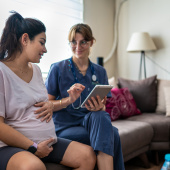
In this article we explain the roles of the following staff. Each pregnant woman or person may see some or all of these.
Anaesthetist
Dentist
General Practitioner
Health Visitor
Maternity Support Worker
Midwife
Neonatal care
Obstetrician
Physiotherapist
Sonographer
Maternity care in the UK
Maternity care is provided by the local NHS Trust or Health Board. In addition, there are some private hospitals which offer maternity care. Each NHS Trust or Health Board draws from the National Institute of Health and Care Excellence (NICE) guidelines and has their own local guidelines.
Care is provided across a range of settings in the community and in hospital. Our article ‘Am I pregnant?’ explains how to book maternity care.
Pregnant women and people can make their own notes on questions they have and what is said during appointments, in case they need to refer to it later.
Everyone is entitled to maternity healthcare from professionals during pregnancy and birth (Birthrights, 2021). Birthrights has more information on the right to NHS services.
What can you expect from health professionals?
Pregnant women and people should expect:
- Care relevant to their individual circumstances and informed by the NICE guidelines.
- Those with specific health conditions will be provided with additional care, informed by NICE guidelines specific to that health condition.
All healthcare professionals should introduce themselves and explain what they do. If they don’t, it’s ok to ask their name and role.
- It may be asked if students can be present for the appointment. This can be accepted or declined.
- Healthcare professionals will encourage the mother or birthing person to ask questions and express personal decisions in maternity care.
Anaesthetist
An anaesthetist [an-eez-the-tist] is a doctor who specialises in offering pain management. This might be remifentanil an epidural during labour, or pain management for a caesarean birth.
Dentist
Dental care is free for pregnant women or people during pregnancy and for a year after birth. A maternity exemption certificate (or MatEx certificate) is needed to qualify, and you get this from the midwife.
General Practitioner (GP / local doctor)
Alongside usual community health support, some GPs also provide all or part of the maternity support (NHS, 2022).
The mother or birthing person will be offered a 6-8 week check with the GP after the baby is born.
The baby will also be offered a check at 6-8 weeks with the GP. Sometimes this runs back-to-back with the mother or birthing person’s appointment (although if the baby was born by surrogate, they would be separate).
Baby vaccinations usually take place at the GP surgery.
Health visitor
The pregnant woman or person will meet a health visitor (HV) during the last part of the pregnancy or soon after birth. These are trained nurses who support families from when the baby is born up to the fifth birthday.
In the first few weeks after the baby is born, the health visitor will usually see the mother or birthing parent and baby several times. This might be at their home, or a child health clinic, children’s centre, GP surgery or health centre.
In cases of surrogacy, where both surrogate and intended parents are UK residents (Gov.uk, 2025):
- The surrogate is offered the usual care for someone who has given birth, and discharge information is passed to the community midwife, GP, and health visitor.
- Discharge information is also shared with the community midwife, GP, and health visitor of the intended parents. The health visitor continues to monitor the child’s progress as routine for any child born in the UK.
Maternity Support Worker or Maternity Care Assistant (MSW or MCA)
MSWs or MCAs are trained to support midwives and do not carry the same level of responsibility. Like midwives what they do depends on their training.
So some might be housekeeping, while others support with breastfeeding, birth support, or more clinical roles (RCM, no date). If unsure you can ask them what their role is.
Midwife
Midwives are trained to take care of the woman or pregnant person during pregnancy, labour and after the baby is born. There will be several visits with the midwife throughout pregnancy.
Midwives may be women or men, and are the primary caregiver for straightforward pregnancy and birth. Specialist midwives support women and birthing people with particular conditions, for example diabetes.
The name of the midwife or midwife team will be in the maternity notes.
Antenatal care may be provided by a community midwife:
- At home
- In a GP surgery or a health centre
- In a midwife-led unit (MLU)
- In a Family Hub
or by a hospital midwife in a hospital maternity unit.
A community midwife might provide both antenatal care and support during birth. Some midwives specialise in working on hospital labour wards and operating theatres, and do not provide antenatal care.
Community midwives usually work in teams, so the pregnant woman or person may not see the same midwife every time. Speak to a senior midwife if:
- Not satisfied with the quality or consistency of care
- A special care pathway is needed for specific circumstances
As part of antenatal care midwives can provide a maternity exemption certificate (or MatEx certificate) which also entitles the person who holds it to free NHS prescriptions and dental care.
If the midwife identifies any concerns about the pregnancy, they can refer the woman or birthing person to an obstetrician, physiotherapist, or another specialist. The pregnant woman or person can also ask for this referral.
A midwife will look after the pregnant woman or person during labour and will support the birth of the baby. If necessary, they will consult with a doctor.
For more complicated labours or births, a doctor will support the birth as well as a midwife. For example, a midwife will be present at a caesarean birth. Our article on where to give birth explains more.
Midwives continue to look after the pregnant woman or person and the baby after birth in hospital or at home. This care continues until the woman or birthing person and the baby is discharged to the care of the health visitor.
In the case of surrogacy, where both surrogate and intended parents are in the UK (Gov.uk, 2025):
- The woman or birthing person has usual midwifery care and discharge after the birth
- The details of the baby and intended parents are shared with their local community midwife, GP and health visitor to ensure they also get the care needed.
Independent midwife
Independent midwives (IM) have chosen to work outside the NHS, providing maternity care in a self-employed capacity (IMUK, no date).
They provide the same antenatal, labour, and postnatal care as the NHS (IMUK, no date). However, IMs charge for their services.
Independent midwives attend home births. In some locations the IM has an agreement with the hospital that they can act as a midwife and provide clinical care. In other locations they can only act as a doula within the hospital.
It is possible to receive care from both the NHS and an independent midwife.
Find out more about Independent Midwifery.
Neonatal care
Neonatal nurse
Neonatal nurses specialise in looking after sick or premature babies who need neonatal care in hospital.
Neonatologist [nee-o-nat-ol-o-jist]
A doctor who specialises in babies and children is a paediatrician [pee-dee-a-trish-un]. A doctor who specialises in the first six weeks of a child’s life is a neonatologist.
They will be present at a more complicated birth, and they lead care in the neonatal unit.
Obstetrician (Doctor)
An obstetrician [ob-ste-trish-an] is a doctor who specialises in more complicated pregnancies and births. The midwife will refer the pregnant woman or person to an obstetrician if certain tests or medical history suggest additional care may be needed.
Obstetricians manage vaginal birth with forceps or ventouse, and perform caesarean birth.
They also manage any complications after birth, such as a retained placenta or more complicated tears.
Physiotherapist
Pelvic pain can be a problem during pregnancy. The woman or birthing person can ask for referral to an obstetric physiotherapist [fizz-ee-o-the-ra-pist].
A physiotherapist can also support with exercises to improve continence (being able to control having a wee) after the baby is born.
Sonographer
An NHS sonographer [son-og-ra-fer] carries out any scans offered during pregnancy, to see how the baby is growing and developing.
Some parents consider using a private sonography service. There is no evidence that this is beneficial, and there is a risk of poor or dangerous information (Wise, 2025).
Further information
A video from Birmingham Symptom-specific Obstetric Triage System (BSOTS) explains how care is prioritised when going to a maternity unit.
The Royal College of Obstetricians and Gynaecologists (RCOG) has a resource on frequently asked questions.
Birthrights (2021) Right to NHS services. https://birthrights.org.uk/factsheets/right-to-nhs-services/ [3 Nov 25]
Birthrights (2024) Unassisted birth. https://birthrights.org.uk/factsheets/unassisted-birth/ [28 Nov 25]
IMUK (no date) About Independent Midwives. https://imuk.org.uk/families-faqs/ [3 Nov 25]
NHS (2022) Your NHS pregnancy journey. https://www.nhs.uk/pregnancy/finding-out/your-nhs-pregnancy-journey/ [3 Nov 25]
RCM (no date) Maternity Support Workers. https://rcm.org.uk/how-to-become-a-maternity-support-worker-msw/ [28 Nov 25]
Wise J. (2025) High street baby scan clinics are putting lives at risk, warn radiographers. BMJ; 391 :r2315 https://doi.org/10.1136/bmj.r2315