What are the benefits of baby massage?
As well as soothing and comforting the baby, massage might (Bennet et al, 2022; Chen et al, 2024):
- improve sleep
- improve physical development
- reduce crying
- increase parent-child attachment
- promote physical growth
- manage digestive issues
- relieve discomfort
- develop body awareness
Baby massage can also help parents (International Association of Baby Massage, no date a):
- connect with their baby and understand their behaviour and communication cues
- increase confidence in meeting the needs of their baby
Are there any drawbacks?
There aren’t any drawbacks as such, but some things to be aware of – such as which kind of oils to avoid.
Going to a class might feel too much for a parent in the very early days, so some parents wait a few weeks before going along to a baby massage class.
Class costs also vary, with prices rising for 1-2-1 sessions.
When can I start?
Massage can be started whenever the parent would like to, as long as the baby seems to enjoy it too. If the mother or birthing parent is attending the class with the baby, they might want to wait until they feel ready to get out and about and follow the routine of a class.
If the baby seems to find structured massage too stimulating in the early days, nurturing touch can be used by parents at first until the baby is ready.
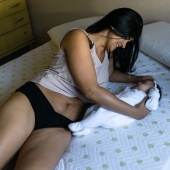
How to give your baby a massage
Before beginning, 'ask permission' by rubbing a little oil between your hands near your baby’s ears, and ask 'can I give you a massage?' This may sound a little strange but your child will become familiar with this cue and know that massage is about to start.
It also gives your baby a chance to let you know if they don’t feel like a massage. They might show this by crying, looking sleepy or showing hunger cues. Watch out for signs that they’re not enjoying it as the massage goes on.
You can massage the whole of the baby’s body using a range of techniques. To get you started, we describe some strokes below for the legs and feet.
- Once you have 'asked permission’, gently hold one of your baby's legs between your palms.
- Then, with one hand, hold your baby's ankle. Mould your other hand around the top of your baby's thigh, then slide it down the leg towards the ankle.
- Swap hands and repeat. Always keep your baby's ankle supported and use slow, flowing strokes.
- Next, cradle your baby’s foot in your hands and use your thumbs to stroke over the sole of the foot from heel to toes, one thumb after another. Hold your fingers in a tripod grip and gently tug each toe between thumb and finger.
- Holding your baby's foot in your hands, walk the thumbs across the middle third of the foot from one side to the other, like a little caterpillar crawling on a leaf.
- You could also do circles on the palms of their hands singing ‘Round and round the garden like a teddy bear’. Continue with finger and thumb tugs.
- Finish by repeating the stroking action in the opposite direction, i.e. from ankle to thigh.
- You can repeat each stroke a few times, always responding to what your baby seems to enjoy.
Which oils can I use?
The International Association of Infant Massage recommends using unscented vegetable oil, preferably organic and cold-pressed if possible.
Sunflower seed oil and almond oil when applied to the skin may improve the skin barrier function (Danby et al, 2013).
Which ones should I avoid?
However, olive oil, mustard seed oil and soybean oil may be bad for the development of the skin barrier (Danby et al, 2013).
Most cases of atopic dermatitis (eczema) appear in the first year of a baby’s life while the skin barrier is developing (Danby et al, 2013).
Therefore, it is important when massaging a baby not to use oils that may have a negative impact on their sensitive skin. These includes oils high in oleic acid, such as olive oil (Danby et al, 2013).
Where can I learn baby massage?
Take a look at the NCT class finder to see if there’s a practitioner near you.
Local Family Hubs often have baby massage classes, so you can see if any baby massage classes are running there.
Bennett, C., Underdown, A., Barlow, J. (2022) Massage for promoting mental and physical health in typically developing infants under the age of six months. Cochrane Database of Systematic Reviews (3) https://doi.org/10.1002/14651858.CD005038.pub3
Chen S-C, Lin SL, Wang M, Cheung DS-T, Liang JG, Cheng Z-Y, Yuen CS, Yeung W-F (2024). Pediatric massage therapy in infants and children under 5 years: An umbrella review of systematic reviews. Heliyon, 10 (16). https://doi.org/10.1016/j.heliyon.2024.e35993
Cooke, A. (2015) Infant massage: the practice and evidence-base to support it. BJM, 23 (3) https://doi.org/10.12968/bjom.2015.23.3.166
Danby, S. G., AlEnezi, T., Sultan, A., Lavender, T., Chittock, J., Brown, K., Cork, M. J. (2013). Effect of olive and sunflower seed oil on the adult skin barrier: implications for neonatal skin care. Pediatric dermatology, 30(1), 42–50. https://doi.org/10.1111/j.1525-1470.2012.01865.x
International Association of Infant Massage (IAIM). (no date a) About baby massage https://www.iaim.org.uk/about-baby-massage/ [Aug 25]
International Association of Infant Massage (IAIM). (no date b) Baby Massage Oil https://www.iaim.org.uk/xs3re5k/Oil-Article-111018.pdf [Aug 25]