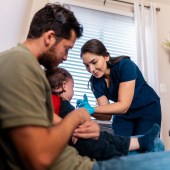
In the UK, babies are offered a vitamin K injection soon after they are born. Vitamin K helps blood to clot and stops bleeding. Newborn babies have low levels of vitamin K, and a small number may bleed because of this. This is called Vitamin K Deficiency Bleeding, or VKDB (NHS Inform, 2025).
A midwife or doctor should explain what vitamin K is before giving it. Parents can decide if they want their baby to have it and they must give verbal consent (NHS Inform, 2025; Powls, 2024). It’s okay to take some time to decide (Wickham, 2025).
Find out more about other postnatal checks and care for babies by joining an NCT Antenatal Course.
What is Vitamin K Deficiency Bleeding?
Vitamin K Deficiency Bleeding (VKDB) is sometimes called Haemorrhagic Disease of the Newborn or HDN. It is a rare illness caused by very low levels of vitamin K in a baby. This can lead to bleeding inside the body (internal bleeding).
The chance of a baby getting VKDB is low, even if they are not given vitamin K. It occurs in about 1 in every 8,500 babies (Powls, 2024).
Most babies who get VKDB recover if they are treated quickly. A small number of babies may have long-term damage. In rare cases, it can cause brain damage or death, but this is extremely uncommon (Powls, 2024; Wickham, 2025).
What is vitamin K?
Vitamin K helps blood to clot. This stops uncontrolled bleeding in the body (Powls, 2024). For adults and older children, vitamin K is found in some foods, like red meat and green vegetables. It is also made by friendly bacteria in the gut (NHS Scotland, no date).
Can all babies have vitamin K?
It is recommended that all babies are given vitamin K soon after birth (NHS Inform, 2025).
Some babies may need vitamin K as a treatment rather than prevention, if they are more likely to bleed. This can happen if a baby is born early, has an infection such as sepsis, has liver problems, or if their blood takes longer than normal to clot (Powls, 2024).
If a pregnant woman or birthing person is taking certain medicines, such as medicine for seizures or some antibiotics, the medicine can stop oral vitamin K from working well in the baby’s body (Powls, 2024). A doctor or midwife will talk about this during pregnancy.
Where can vitamin K be given?
A midwife or doctor can give vitamin K in all birth settings - at home, in a mid-wife led unit, or in hospital.
How is vitamin K given?
Babies can be given vitamin K in two ways. The most common way is one injection soon after birth (NHS Inform, 2025).
Vitamin K can also be given by mouth. A baby will need (NHS Inform, 2025):
- Two oral doses in the first week, if they are fed with formula milk.
- Two doses in the first week, and a third dose when they’re a month old, if they are breastfed or chestfed.
This difference in doses is because vitamin K is added to formula milk (Wickham, 2025).
There are no research trials comparing giving vitamin K by mouth and by injection. Some data suggests there’s little difference between the two, if all the oral doses are given (Jullien, 2021). If a dose is missed, or the baby spits up or vomits, they may not take in the prescribed dose (Powls, 2024; Hand et al, 2022).
Oral vitamin K is not recommended for babies who have a high risk of bleeding, are unwell, or born early (Powls, 2025). These babies will be recommended to have vitamin K injection.
How effective is vitamin K?
Studies show that vitamin K is very effective at preventing VKDB, especially when given by injection (Wickham, 2025).
Is vitamin K safe for babies?
Vitamin K is given to millions of babies every year worldwide. It is considered very safe (Wickham, 2025).
There has not been much research about its side effects, why babies are born with lower levels of vitamin K than adults, or if this helps them in some way (Wickham, 2025). However, vitamin K has been given to babies for over 50 years with no significant reports of any issues.
A baby may feel some pain when the vitamin K injection is given. Research shows that holding a baby skin-to-skin can help with the pain (Patel et al, 2022).
As with any injection, there is also a small chance of bruising or infection on the baby’s skin (Wickham, 2025).
How to detect a vitamin K deficiency
If parents decide not to give their baby vitamin K, it’s important to know the signs of low vitamin K and VKDB. If babies are treated quickly, they usually recover (Wickham, 2025).
Get medical help straight away if a baby is (NHS Scotland, no date; Wickham, 2021):
- Easily bruising, especially around the head and face
- Bleeding from the nose, mouth, gums, or umbilical cord
- Bleeding from the site of a previous medical intervention, such as the heel prick test
- Jaundiced (yellow eyes and skin) after the first two-three weeks (for babies with darker skin colours, jaundice may be harder to detect. Yellowing may appear in the whites of the eyes, palms of the hands, soles of the feet, or inside the mouth and gums).
- Having blood in their wee or poo
- Having black tarry stool, after the first 2-3 days when meconium has passed
- Vomiting blood or repeatedly vomiting
- Paler than usual in skin colour (for babies with darker skin colours, any change may be more easily detected by looking at the gums).
- Having seizures
- Displaying changes in behaviour, such as excessive sleepiness, not eating, or irritability
It can be hard for parents to know what is normal for a new baby. Many of these signs can be harmless. Midwives can answer any questions or concerns.
Are there any factors that make a baby more prone to vitamin K deficiency?
Vitamin K is added to formula milk and is also found in low levels in breastmilk. If a baby is not feeding well or not getting enough milk, they may be more likely to have low levels of vitamin K. Babies who are breastfed or chestfed may be more likely to have low levels of vitamin K than those that are fed formula milk (Powls, 2024; Wickham 2021).
Babies with liver disease are also more at risk of VKDB. Small, repeated doses of vitamin K by mouth can help lower the risk. Sometimes, liver problems are not noticed for days or weeks after birth. If a baby still has jaundice after 14 days, this could be a sign that they need treatment (Powls, 2024).
Need more information?
Every woman and birthing person has the right to feel safe, informed, supported, and confident about their decisions.
For further information, we offer NCT Antenatal Courses, which are a great way to find out more about labour, birth, and the early days with a new baby.
Our NCT support line also offers practical and emotional support with feeding your baby and general enquiries for parents, members and volunteers: 0300 330 0700.
Hand I, Noble L, Abrams SA. (2022) Vitamin K and the Newborn Infant. Pediatrics. Mar 1;149(3):e2021056036. https://doi.org/10.1542/peds.2021-056036
Jullien S. (2021) Vitamin K prophylaxis in newborns. BMC Pediatr. ;21(Suppl 1):350. https://doi.org/10.1186/s12887-021-02701-4
NHS Inform (2025) Vitamin K and your new baby. https://www.nhsinform.scot/ready-steady-baby/labour-and-birth/after-the-birth/vitamin-k-and-your-new-baby/ [29 Oct 25]
NHS Scotland (n.d.) Vitamin K for Newborn Babies: Parent information https://clinicalguidelines.scot.nhs.uk/media/2083/vitamin-k-for-newborn-babies.pdf [30 Oct 25]
Patel DV, Soni SN, Shukla VV, Phatak AG, Shinde MK, Nimbalkar AS, & Nimbalkar SM, (2022) Efficacy of Skin-to-Skin Care versus Swaddling for Pain Control Associated with Vitamin K Administration in Full-Term Neonates: A Randomized Controlled Trial, Journal of Tropical Pediatrics, Volume 68, Issue 4, fmac052, https://doi.org/10.1093/tropej/fmac052
Powls, A (2024) Vitamin K Prophylaxis for Neonates, Wos MCN (695) West of Scotland Neonatology Managed Clinical Network https://clinicalguidelines.scot.nhs.uk/ggc-paediatric-guidelines/ggc-paediatric-guidelines/neonatology/vitamin-k-prophylaxis-for-neonates-wos-mcn-695/ [Oct 25]
Wickham, S (2021) Five things parents should know if they decide to decline vitamin K for their baby https://www.sarawickham.com/original-articles/five-things-parents-should-know-if-they-decide-to-decline-vitamin-k-for-their-baby/ [29 Oct 25]
Wickham, S (2024) Seven things every parent needs to know about vitamin K https://www.sarawickham.com/articles-2/information-about-vitamin-k/ [29 Oct 25]