What is an assisted vaginal birth?
An assisted vaginal birth is a vaginal birth where forceps [for-seps] (metal spoons) or ventouse [von-tooz] (a suction cup) are used to help the baby be born. They’ll only be offered when it’s considered medically necessary, and the woman or birthing person decides to accept or decline if they are used (NHS, 2023).
They are most common when the woman or birthing person has not previously had a spontaneous vaginal birth (RCOG, 2023):
- About 1 in 3 women or birthing people have an assisted vaginal birth with their first baby.
- About 1 in 8 women or birthing people overall have an assisted birth.
Our antenatal courses help prepare parents for what might happen during birth, explore their options and what it might mean for parents and baby.
What are ventouse and forceps?
A ventouse is a vacuum cup which is attached to a baby’s head by suction. It is made of metal or soft or hard plastic and fits firmly onto the baby’s head (NHS, 2023).
Forceps are smooth, curved metal instruments, like spoons or tongs, that fit around the baby’s head. There are various types for different situations. For example, some are used to turn the baby into a better position, rather than help the baby be born (NHS, 2023).
How are they used?
When the mother or birthing person has a contraction, the midwife or obstetrician use the ventouse or forceps to gently guide or pull the baby (NHS, 2023; RCOG, 2023).
If the baby has not been born after two or three attempts, a caesarean birth may be recommended.
Which one will be used?
The healthcare professionals will consider the situation and their experience when deciding whether to use forceps or ventouse (NICE, 2023). It is possible you can discuss the choice and the reasons for their preference with them.
Forceps may be used rather than ventouse if the baby is less than 36 weeks gestation. At this stage of pregnancy, the baby’s skull is softer and at more risk of injury from the suction cup of the ventouse (NHS, 2023).
When are they offered?
Forceps and ventouse will be offered if (NHS, 2023; RCOG, 2023):
- There are concerns about the baby’s wellbeing, meaning they need to be born soon
- The baby is in an awkward position, which might mean labour is not progressing as expected
- The mother or birthing person can’t push during birth, or has been told not to push because of an underlying health condition
Are they safe for babies?
Forceps and ventouse are commonly used as they are considered safe for the baby (NHS, 2023).
Most babies born by forceps or ventouse are well at birth. They aren’t usually affected in the long term (RCOG, 2023).
What makes an assisted vaginal birth less likely?
Several factors might make it less likely that an assisted birth will be needed (RCOG, 2023):
- An uncomplicated pregnancy
- Planning birth at home or in a midwife-led unit (MLU)
- Having birth partner support during labour
- Using upright birth positions or lying on the side when the cervix is fully open
- Delaying pushing until the urge is strong
Where does an assisted vaginal birth take place?
Assisted vaginal births take place in a hospital labour ward. If it is expected to be straightforward then it’s possible to remain in the labour room (RCOG, 2023).
If the birth is thought to be more complicated, the woman or birthing person may be moved from a labour room into an operating theatre. This is in case a caesarean birth becomes necessary (RCOG, 2023).
What happens during an assisted vaginal birth?
- The mother or birthing person will be asked for their consent to examine the abdomen and have an internal (vaginal) examination. The bladder may be emptied using a small tube (RCOG, 2023).
- Pain management is offered for assisted vaginal birth. A local anaesthetic injection may be given into the vagina, or a spinal injection will be given into the back. If there is already an epidural in place, this may be topped up (RCOG, 2023).
- The mother or birthing person is more likely to be asked to consent to a cut (called an episiotomy) to make the vaginal opening bigger (RCOG, 2023).
- An extra health professional who specialises in newborn care may be present (RCOG, 2023).
After the birth:
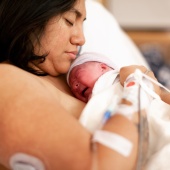
- Skin-to-skin contact and delayed cord clamping are possible straight after birth if the baby does not need extra care (RCOG, 2023).
- The mother or birthing person may be given antibiotics through a drip to reduce the chance of infection (RCOG, 2023).
- If an epidural was used, a urinary catheter (a small tube to drain the bladder) may stay in place for up to 24 hours (NHS, 2023).
- Postnatal bleeding may be heavier at first, but then reduce to normal levels (RCOG, 2023).
What are the risks of forceps or ventouse?
Birth with ventouse and forceps increases the likelihood of the mother or birthing person experiencing perineal trauma. It is also more likely that this is a third or fourth-degree tear, which involves the muscle and / or the wall of the anus or rectum (NHS, 2023; RCOG, 2023).
The mother or birthing person may need to stay in hospital for longer than planned after the birth (RCOG, 2023).
A vaginal birth that is assisted by ventouse or forceps can increase the risk of blood clots developing in the legs or pelvis. Moving around after the birth can help prevent this (NHS, 2023).
Urinary or anal incontinence is more common after an assisted vaginal birth. Physiotherapy and advice on pelvic floor exercises should be offered (NHS, 2023).
How it may affect the baby:
- Bruising, swelling or small cuts on the baby’s head are common, but should go away within a few days (NHS, 2023).
- Babies born by assisted vaginal birth are more likely to develop jaundice, and this usually gets better within a few days (NHS, 2023).
- After an assisted birth, a baby may find feeding more difficult if they have a sore head or neck. Parents can ask for additional support with feeding their baby.
What are the benefits?
Forceps and ventouse can help the mother or birthing person to birth the baby without an unplanned caesarean birth.
What are the alternatives?
The alternatives are to wait for the baby to be born without assistance, or have an unplanned caesarean birth. Caesarean birth will be advised if vaginal birth is no longer thought to be possible (NICE, 2023; RCOG, 2023).
Choices may be limited if the situation becomes urgent or for safety reasons. For example, if the baby’s head is too low down in the pelvis for caesarean birth (NICE, 2023).
The mother or birthing parent might decide to choose a planned caesarean birth if they are sure they would not want an assisted vaginal birth. This is because an unplanned caesarean birth is more complex than a planned caesarean birth (RCOG, 2023).
When is assisted vaginal birth less likely to be successful?
Assisted vaginal birth may be less effective if (RCOG, 2023):
- The mother or birthing person has a BMI of over 30
- They are less than 161cm tall
- The baby is estimated to be weigh more than 4kg
- The baby is in a back-to-back position
- The baby’s head is not low down in the birth canal
What can birth partners do?
It can be helpful to think in advance about the support the woman or birthing person would want if having a vaginal birth assisted by forceps or ventouse. This could mean offering reassurance if this is a change to the birth plan, or simply holding their hand during the birth.
Some birth partners have said they found it difficult watching the use of forceps or ventouse. So, they might consider where they stand during the birth.
It’s always also a good idea to talk about birth plans ahead of time. This way, everyone is clear on whether the birth partner should stay with the mother or birthing person, or baby, if the baby needs to move to special care.
Further information
Our support line offers practical and emotional support with feeding your baby and general enquiries for parents, members and volunteers: 0300 330 0700.
We also offer antenatal courses which are a great way to find out more about birth, labour and life with a new baby.
Make friends with other parents-to-be and new parents in your local area for support and friendship by seeing what NCT activities are happening nearby.
NHS (2023) Forceps or vacuum delivery. https://www.nhs.uk/pregnancy/labour-and-birth/what-happens/forceps-or-v… [30 Sep 25]
NICE (2023) Intrapartum Care [NG235]. https://www.nice.org.uk/guidance/ng235 [30 Sep 25]
RCOG (2023) Assisted vaginal birth (ventouse or forceps). https://www.rcog.org.uk/for-the-public/browse-our-patient-information/a… [30 Sep 25]