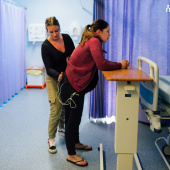
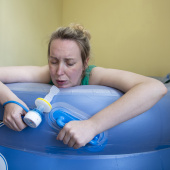
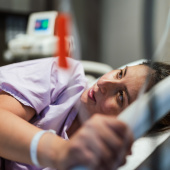
Research shows that being in pain and anxious can make it hard to consider the risks and side effects when making a decision about pain management. So it’s recommended to be familiar with how it works before labour (Saeb et al, 2025).
Our Antenatal courses provide a good opportunity to discuss pain management with others.
What is an epidural?
An epidural is the name used for a painkiller given through a fine tube inserted into the back. This gives pain relief close to the nerves of the spine. Epidurals can be effective at removing pain while the woman or birthing person remains awake and able to make decisions ( NHS, 2023a; LabourPains, no date; Thomson et al, 2019).
Epidurals are given by a doctor called an anaesthetist [an-eez-the-tist], who is specially trained to do this (LabourPains, no date).
What are a spinal and a combined spinal epidural (CSE)?
A spinal is a single injection of painkiller into the same space as the epidural would go (LabourPains, no date). It is also given by an anaesthetist. This might be used if someone does not have an epidural set up and is now having an assisted vaginal birth or caesarean birth.
If seeking pain management late in labour the mother or birthing parent may have a one-off spinal injection at the same time as an epidural tube is inserted. This can give immediate pain relief rather than waiting for the epidural to work. It is known as combined spinal epidural (CSE) (Labour Pains, no date).
Why is an epidural used during labour?
Epidurals numb the nerves and can stop the mother or birthing person feeling pain during labour. The painkillers used in epidurals may be a local anaesthetic, a small dose of opioids or a mixture of both (LabourPains, no date).
What are mobile epidurals?
An epidural removes sensations, making the mother or birthing person feel weak or numb in the belly and legs (NHS, 2023a).
A ‘mobile’ or ‘lower dose’ epidural means a lower dose of painkillers is given, so there is less numbness. This means it is possible to be mobile and feel more, which can help birth the baby (LabourPains, no date; NHS, 2023a).
However, as the area isn’t completely numb, some discomfort will still be felt (LabourPains, no date).
How is an epidural given?
During an epidural (LabourPains, no date; NHS, 2023a):
- The woman or birthing person will have a canula (a fine plastic tube) put into their hand. This allows fluids to be given while they are having the epidural.
- They will be asked to sit curled forward.
- The anaesthetist cleans their back with antiseptic.
- The anaesthetist then injects a local anaesthetic under the skin on the back.
- The woman or birthing person sits very still while the epidural tube is put into their back with a needle.
- The needle is removed, and the tube is left taped in place during labour, allowing the woman or birthing person to move freely.
- Painkillers are given through the tube.
An epidural takes up to 20 minutes to set up, and 20-30 minutes to work (Labour Pains, no date; NHS, 2023a).
Because an anaesthetist is needed to set up the epidural there may be a wait while they support other people. This wait could be as long as two hours. It can be helpful for the birth partner to offer other coping strategies for the labouring woman or person during this period.
Once set up, the anaesthetist will check that the epidural is working using a cold spray or ice on the tummy and legs (LabourPains, no date).
There will be regular checks of blood pressure while the epidural is in place (LabourPains, no date).
How long does it last?
An epidural is topped up during labour if needed. This might be done by the health professional as a one-off injection, or using a pump. This might be set at a steady flow, or as patient-controlled epidural analgesia (PCEA), where the labouring woman or person presses a button for a top-up when needed (LabourPains, no date).
When the epidural is stopped, the numbness lasts for a few hours before wearing off (LabourPains, no date; NHS, 2023a).
However, no-one should plan to drive for 24 hours after an epidural (NHS, 2023a).
Can epidurals be used for assisted or caesarean birth?
Epidurals are often topped up if the decision is made for a caesarean birth, or a vaginal birth assisted with forceps or ventouse (LabourPains, no date).
If there is no epidural in place then a spinal will be used.
Do they always work?
Epidurals are usually highly effective, but occasionally do not stop all the pain. In which case an epidural might be adjusted, topped up, or withdrawn and given again (NHS, 2023b; LabourPains, no date).
In about one in 20 cases an epidural alone doesn’t prevent enough pain for a caesarean birth. In this situation a spinal may be added, or a general anaesthetic used. Epidural is considered safer than general anaesthetic for the woman or pregnant person, and the baby (LabourPains, no date).
Is having an epidural more likely to lead to caesarean birth?
Research conducted after 2005 shows that modern epidurals don’t increase the chance of caesarean birth or assisted vaginal birth (Anim-Somuah et al, 2018; LabourPains, no date).
However, other research shows that moving between side-lying positions rather than lying on the back led to more vaginal births and a better experience when an epidural was in place (Walker et al, 2018).
Can everyone have them?
Epidurals may not be suitable for women and birthing people with certain medical conditions including (LabourPains, no date):
- Spina bifida
- A previous operation on the back
- Problems with blood clotting
It is helpful to discuss pain management options with these conditions before labour begins (LabourPains, no date).
Benefits of epidurals (LabourPains, no date; Thomson et al, 2019)
- Epidurals can be the most effective way of relieving pain during labour, helping women and birthing people feel in control.
- They can be topped up in the case of caesarean birth or assisted vaginal birth.
- They should not cause drowsiness or nausea in the mother or birthing person.
- Epidurals have very little effect on the baby, and do not make it harder to breastfeed.
Drawbacks of epidurals (LabourPains, no date; NHS, 2023b; Thomson et al, 2019)
- Skin might feel itchy.
- The woman or birthing person could develop a slight fever.
- There is a higher chance of the mother or birthing person having low blood pressure, which may lead to feeling sick. This will be monitored.
- It is hard to urinate (have a wee) when you have an epidural. A tube into the bladder may be used to drain the urine.
- For one in 8 women or birthing people the epidural may not stop all pain, so another method of pain management may also be needed.
- The second stage of labour will be longer, and more medication may be needed to strengthen contractions.
- Where a higher dose epidural is used there is a higher chance of having a vaginal birth assisted with ventouse or forceps.
- One in every 20 women or birthing people may get a headache after an epidural.
- For one in 100 people, this headache is severe and can last for days or weeks if not treated. It is caused by the needle puncturing the bag of fluid surrounding the spine. In this case, the medical team should be told and they can help to treat it.
- Temporary nerve damage is uncommon but may happen. Numbness usually gets better within weeks.
- Permanent nerve damage is also possible but very rare (happening to about 1 in 13,000 women or birthing people).
- While considered effective for reducing pain, women and birthing people who use epidurals report more negative effects and lower satisfaction than those who use less effective methods of pain relief.
Further information
LabourPains is the public site from the Obstetric Anaesthetists Association (OAA). They have an information card and infographics.
Anim-Somuah M, Smyth RM, Cyna AM, Cuthbert A. (2018) Epidural versus non-epidural or no analgesia for pain management in labour. Cochrane Database Syst Rev. May 21;5(5):CD000331. https://doi.org/10.1002/14651858.CD000331.pub4
LabourPains (No date) Epidural analgesia. https://www.labourpains.org/during-labour/epidural-advice-and-informati… [30 Sep 25]
Lawrence A, Lewis L, Hofmeyr GJ, Styles C. (2013) Maternal positions and mobility during first stage labour. Cochrane Database of Systematic Reviews, Issue 10. Art. No.: CD003934. https://doi.org/10.1002/14651858.CD003934.pub4
NHS (2023a) Epidural: Overview. https://www.nhs.uk/tests-and-treatments/epidural/ [30 Sep 25]
NHS (2023b) Epidural: Side effects. https://www.nhs.uk/tests-and-treatments/epidural/side-effects/ [30 Sep 25]
Saeb S, Korst LM, Farahnik F, McCulloch J, Greene N, Fridman M, Gregory KD. (2025) The Childbirth Experience Survey (CBEX): An Analysis of Qualitative Survey data. Matern Child Health J. Apr;29(4):457-464. https://doi.org/10.1007/s10995-025-04043-4
Thomson G, Feeley C, Moran VH, Downe S, Oladapo OT. (2019) Women's experiences of pharmacological and non-pharmacological pain relief methods for labour and childbirth: a qualitative systematic review. Reprod Health. May 30;16(1):71. https://doi.org/10.1186/s12978-019-0735-4
Walker KF, Kibuka M, Thornton JG, Jones NW. (2018) Maternal position in the second stage of labour for women with epidural anaesthesia. Cochrane Database of Systematic Reviews, Issue 11. Art. No.: CD008070. https://doi.org/10.1002/14651858.CD008070.pub4