What is a sling, wrap or carrier?
A sling, wrap or carrier provides comfort and support for the baby and allows you to carry a child hands-free. It’s not a new idea and has been practised for centuries in different cultures. We’ll use the terms sling, wrap and carrier interchangeably in the rest of this article.
There are lots of types of slings so it’s worth finding out about the different styles. You could even try a few before you choose one. NCT has sling libraries where you can do this, which you can find here or email enquiries@nct.org.uk.
Are there are any benefits to using a sling?
Practical
Many carers say it’s practical, whatever your lifestyle.
Good for getting around
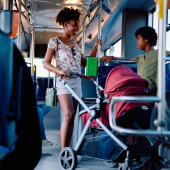
Slings help with moving around as they are easier to use in some places than pushchairs. For example, lifts, steps, narrow doors and pavements are easier to navigate. They can be simpler to use on public transport or in the countryside. Some babies resist the pushchair but are calm in the sling (Whittle, 2019).
Useful with more than one child
Parents or caregivers of more than one baby may find it easier if one baby is held in a sling. They can provide an accessible way for those with limited mobility to transport or care for their baby (Krassioucov et al, 2024). Co-parents and caregivers can use slings to share the parenting load while gaining closeness and nurturing the baby (Whittle, 2021).
Builds attachment
Research shows that babywearing helps build attachment. It also makes the wearer more responsive to the baby’s needs (Williams & Turner, 2020). It promotes the baby’s sleep regulation, speech, social and emotional development (Norholt, 2020).
Can improve mental health
For parents and caregivers, it can improve positive mental health. Research shows it can help reduce stress, fatigue and insomnia (Norholt, 2020; Havens et al, 2022; Whittle, 2021).
Positive effect on breastfeeding
Using a sling for at least an hour a day is linked to more frequent breastfeeding (the baby should always be taken out of the carrier to feed). It might also help to extend the breastfeeding relationship. This includes the use of expressed breastmilk in a bottle (Pisacane et al, 2012; Little et al, 2021).
This might be because the wearer responds better to the baby’s cues or because close contact stimulates the hormones involved in breast or chest feeding (Pisacane et al, 2012).
Sling safety guidelines
In 2026 The Lullaby Trust, with input from NCT and a working group of sling experts, parenting and accident prevention charities and organisations, created the following guidelines for using a sling or carrier. Visit The Lullaby Trust for detailed pictures and more information.
When you use a sling or carrier, make sure your baby is upright and can breathe easily.
There are three important checks to make sure your baby is high, in-sight and tightened just right:
- High. Your baby should be high on the firm part of your chest. You should be able to kiss their head easily.
- In-sight. Your baby should be upright, with their mouth and nose in-sight. Their mouth and nose should be clear so they can breathe easily (a clear airway).
- Tightened just right. The sling or carrier should hold your baby tight against you. Their back should be evenly supported, with nothing pushing behind their head.
- If you were to lean slightly forward, supporting your baby's head, their body should stay tight against yours.
- The carrier isn't too tight if you can fit your fingers between the firm part of your chest and your baby's chest.
Regularly check your baby is high, in-sight and tightened just right when you are using your sling or carrier and reposition them if needed.
Always check your baby’s airway (breathing tube) is clear.
Keep making sure:
- Their head is not bent forwards with their chin touching their chest.
- Their head is not tipped back.
- Their nose and mouth are not covered by fabric or your body.
Young, premature and low birthweight babies have heavy heads and weak necks. This makes their airway (ability to breathe) more at risk in slings and carriers.
Feeding your baby
It is safest to take your baby out of the sling or carrier for feeding.
If you do feed your baby in a sling or carrier:
- Hold your baby and give them your full attention.
- Always check that their airway is clear.
After feeding, put your baby back in the high, in-sight and tightened just right position. Do not let them sleep in the sling or carrier in the same position they were feeding in.
Keeping your baby at the right temperature
Dress your baby in light layers.
Check if your baby is too hot by feeling their chest or the back of their neck.
- If their skin feels hot or sweaty, remove one or more layers of clothing.
- If their chest feels cold, add a light layer over the sling or carrier, remembering to keep baby’s mouth and nose in-sight.
If your baby falls asleep, make sure they are still high, in-sight and tightened just right:
- Check they are a comfortable temperature and their airway is clear.
- Take your baby out of the sling or carrier if you are tired or need to lie down.
If you have drunk alcohol, or taken drugs or medicines that make you sleepy, don’t use a sling or baby carrier.
Check the manufacturer’s instructions for more information on your individual sling or carrier.
What should I be aware of when I use a sling, wrap or carrier?
When it comes to using slings, it’s very important to follow a few simple guidelines.
Choosing and buying a sling
- Check the manufacturer’s instructions. Follow their advice on whether the baby’s size, weight and age are right for the carrier.
- Not all slings or carriers suit all adult or baby body types. Find one that works for both the wearer and the baby. For some families that might mean each parent uses a different carrier. Different wearers using the same sling might need to adjust the straps to their body before use.
- If you bought the sling second-hand and the instructions are missing, contact the manufacturer. You may be able to download a copy from their website. Many manufacturers have videos on their website on how to secure the sling safely. However, be aware that some sling demonstrations on social media are by untrained influencers and may not be safe.
- Before you use a second-hand sling or carrier, check for signs of wear and tear. Don't use it if you have any concerns.
Using a sling
- It’s important for the sling or carrier to be comfortable for the wearer. If it is not comfortable, try adjusting the sling or using a different carrier. Sling consultants will be able to demonstrate different slings.
- Temperature regulation is critical for young babies, so remember a baby will be picking up the wearer's body heat. In cold weather, follow the same guidelines as for car seats to keep the baby safe. That means putting additional protective layers outside the carrier, so the straps fit snugly to the baby. Ensure that any layers outside the carrier do not cover the baby's head or face.
- If the carrier is being used in any other way than the manufacturer's instructions, the baby should be held as if in arms only. The wearer should not do any activity that they wouldn't do with the baby held in arms only.
Cautions for the adult user
- The adult wearer needs to be alert, feeling well, and not distracted.
- Smoking should be avoided for an hour before holding and carrying babies, and while holding or carrying them.
- Drinking alcohol should be avoided so the wearer is more alert to the baby’s needs (La Leche League, 2026).
- Never sleep while wearing a baby in a sling or carrier.
- Don’t cook or hold anything that a toddler might harm themselves if they reached out and grabbed, like sharp knives (La Leche League, 2026).
- When wearing a sling, pick up objects from the floor by bending at the knees with one hand on the baby, rather than leaning forward (La Leche League, 2026).
- Baby car seats should always be used when driving in a car. Slings are not designed to provide protection in a moving vehicle (La Leche League, 2026).
How should the baby be held?
- The safest baby carrier holds the baby upright and facing them (NHS, 2024).
- It supports their body well and keeps them close to the wearer's body. This way, the wearer can always see their face.
- The baby's weight should be distributed evenly across the wearer's shoulders, hips and back (ROSPA, no date).
- It should feel comfortable – if it feels loose or unbalanced, try again or ask for help.
- When the baby is in the wrap, check them often, making sure their nose and mouth are clear so they can breathe easily.
- Keep their chin off their chest and make sure nothing is covering their face (RoSPA, no date; NHS, 2024). This is especially important when carrying young babies under four months old.
- Regularly check that the baby's legs are a normal colour. Red or purple legs could suggest that the sling is too tight and blood flow to the legs is being restricted (La Leche Leage, 2024).
Baby positions for slings and carriers
For the first six months of a baby's life, a recommended position is known as the spread squat, jockey position or M-position. It helps their hips develop correctly and encourages social development as they are facing their parent or caregiver (International Hip Dysplasia Institute, No date). This also makes it easier to keep them in view at all times.
- The spread squat is where the baby is facing their adult and has their thighs spread around the wearer’s torso.
- The baby also has their hips bent so their knees are slightly higher than their bottom.
- Alternatively, the baby's knees are level with their bottom and with the thighs supported.
- It is particularly important if a baby is being held in a sling for long periods of time.
- Read more about hip dysplasia (unstable hips).
Using back carriers
Front carriers are recommended for the first 6 months of a baby's life. When the baby is older and heavier, back carriers with hard frames may be more suitable for long walks and hiking (La Leche League, 2024).
What are the risks of using slings?
When using a sling, it’s important to follow the manufacturer’s guidelines to reduce any risks. Anyone carrying a baby in a sling should follow the manufacturer's guidelines to reduce risks.
Although rare, very sadly, some babies have been injured or died in baby slings and carriers. Young babies do not have strong neck control and cannot lift their head, so their airway can easily be covered or compressed. The airway is clear when the baby is in a neutral position.
A sling’s fabric or fabric from the parent or caregiver’s clothing can also cause suffocation very quickly (Batra et al, 2015). If the sling or carrier is not correctly fitted and adjusted, babies can experience traumatic head injuries (Rowe et al, 2022).
If the baby was born prematurely, with a low birth weight or has a medical condition, talk to a health professional before using a carrier or sling. They can help you understand how to safely use it.
For the wearer, using a sling can lead to back pain (Havens et al, 2022). Getting good one-to-one guidance on how to correctly use the sling might prevent this.
Further information
For more information on the slings available, find your nearest NCT sling library. Our sling libraries have a wide variety of slings and carriers to try and hire so you can find which one works best for you.
The Twins Trust has information on caring for twins and multiples, including safe use of slings.
To feel confident in the sling or carrier you are buying, check the government website for safety recalls.
New guidance added to article 25 November 2026.
Batra EK, Midgett JD, Moon RY. (2015) Hazards associated with sitting and carrying devices for children two years and younger. J Pediatr. 167(1):183-187. https://doi.org/10.1016/j.jpeds.2015.03.044
Havens, KL et al (2022) Infant Carrying in the United States: A Survey of Current Practices, Physical and Mental Health Benefits, and Challenges of Babywearing. Journal of Women's Health Physical Therapy. 46(1):p 25-34. https://doi.org/10.1097/JWH.0000000000000227
International Hip Dysplasia Institute. (no date) Baby wearing. https://hipdysplasia.org/baby-wearing/ [7 Jan 25]
Krassioukov A, et al (2024) Breastfeeding Following Spinal Cord Injury: Consumer Guide for Mothers. Top Spinal Cord Inj Rehabil; 30 (2): 54–64. https://doi.org/10.46292/sci23-00080
La Leche League International. (2024) Babywearing: More than a means to carry your baby!
https://llli.org/breastfeeding-info/babywearing/ [12 Oct 26]
Little EE, Cioffi CC, Bain L, Legare CH, Hahn-Holbrook J (2021) An Infant Carrier Intervention and Breastfeeding Duration: A Randomized Controlled Trial. Pediatrics; 148 (1): e2020049717. https://doi.org/10.1542/peds.2020-049717
Norholt H. (2020) Revisiting the roots of attachment: A review of the biological and psychological effects of maternal skin-to-skin contact and carrying of full-term infants. Infant Behav Dev. 60:101441. https://doi.org/10.1016/j.infbeh.2020.101441
NHS (2024) Reduce the risk of sudden infant death syndrome (SIDS). https://www.nhs.uk/conditions/baby/caring-for-a-newborn/reduce-the-risk… [8 Jan 25]
Pisacane A, Continisio P, Filosa C, Tagiamonte V, Continisio I. (2012) Use of baby carriers to increase breastfeeding duration among term infants: the effects of an educational intervention in Italy. Acta Paediatr. 101(10):e434-8. https://doi.org/10.1111/j.1651-2227.2012.02758.x
ROSPA. (no date) Baby slings. https://www.rospa.com/home-safety/product-safety/baby-sling [7 Jan 25]
Rowe S, Reeves P, McAdams R, Roberts K, Dobson N, McKenzie L. (2022) Baby wearing injuries presenting to emergency departments, 2011-2020: a dangerous fashion trend. Pediatrics. 149 (1) :962 https://publications.aap.org/pediatrics/article/149/1%20Meeting%20Abstr… [7 Jan 25]
Whittle R. (2019) Baby on board: the impact of sling use on experiences of family mobility with babies and young children. Mobilities. 14(2). https://doi.org/10.1080/17450101.2018.1533682
Whittle R. (2021) Towards interdependence: using slings to inspire a new understanding of parental care. Child Geogr. https://doi.org/10.1080/14733285.2021.1955091
Williams L, Turner P. (2020) Experiences with “babywearing”: trendy parenting gear or a developmentally attuned parenting tool? Child Youth Serv Rev. 112:104918. https://doi.org/10.1016/j.childyouth.2020.104918