Get an urgent GP appointment or call 111 if a baby (NHS, 2024 b):
- Has a rash you are worried about
- Feels hotter than usual, is sweaty or shivering
- Has a temperature of 38C or above under 3 months or 39C or above over 3 months
See the NHS page on rashes in babies and children, and when to seek urgent medical attention.
Day-to-day skincare for babies
When a baby is born, their skin may be covered in a sticky white substance called vernix [ver-nix]. This natural moisturiser protects the baby’s skin in the womb and early days and shouldn’t be washed off. It will be absorbed by the skin over time (NHS, 2024 a).
A newborn’s skin is delicate and over the first month it develops a protective barrier. This can take longer for premature babies, and neonatal staff can give guidance (NHS, 2024 a).
For at least the first month plain water is enough to clean the skin, and no cleansers, soaps or lotions are needed (NHS, 2024 a).
It’s not necessary to use moisturisers on a healthy baby’s skin, and they do not prevent conditions like eczema [ex-ma]. Moisturisers may increase the chance of developing a food allergy and probably lead to more skin infections (Kelleher et al, 2022).
Can I use baby wipes?
A cotton ball or very soft natural fibre cloth dipped in plain water and slightly squeezed out is commonly used by parents at home. If using disposable wipes, choose alcohol-free and fragrance-free products if possible (NHS, 2024 a).
It is difficult to test products on babies’ skin because of ethical and safety concerns. As a result, not much is known about how the ingredients are absorbed into the skin. The studies done suggest that wipes are generally safe to use (Rahma and Lane, 2022).
Parents can check the ingredients used in wipes and stop using anything that seems to irritate the baby’s skin.
What about oils?
Massaging a baby can be a lovely way to bond with them. Coconut oil is safe to use for most babies (NHS, 2024 b; Noveir et al, 2024).
Avoid olive oil as it may not be suitable for skin. Do not use peanut oil which may be an allergy risk (NHS, 2024 b).
Nappy rash
When the skin on a baby’s bottom becomes sore, this is called nappy rash. It is common, and may look or feel (NHS, 2023):
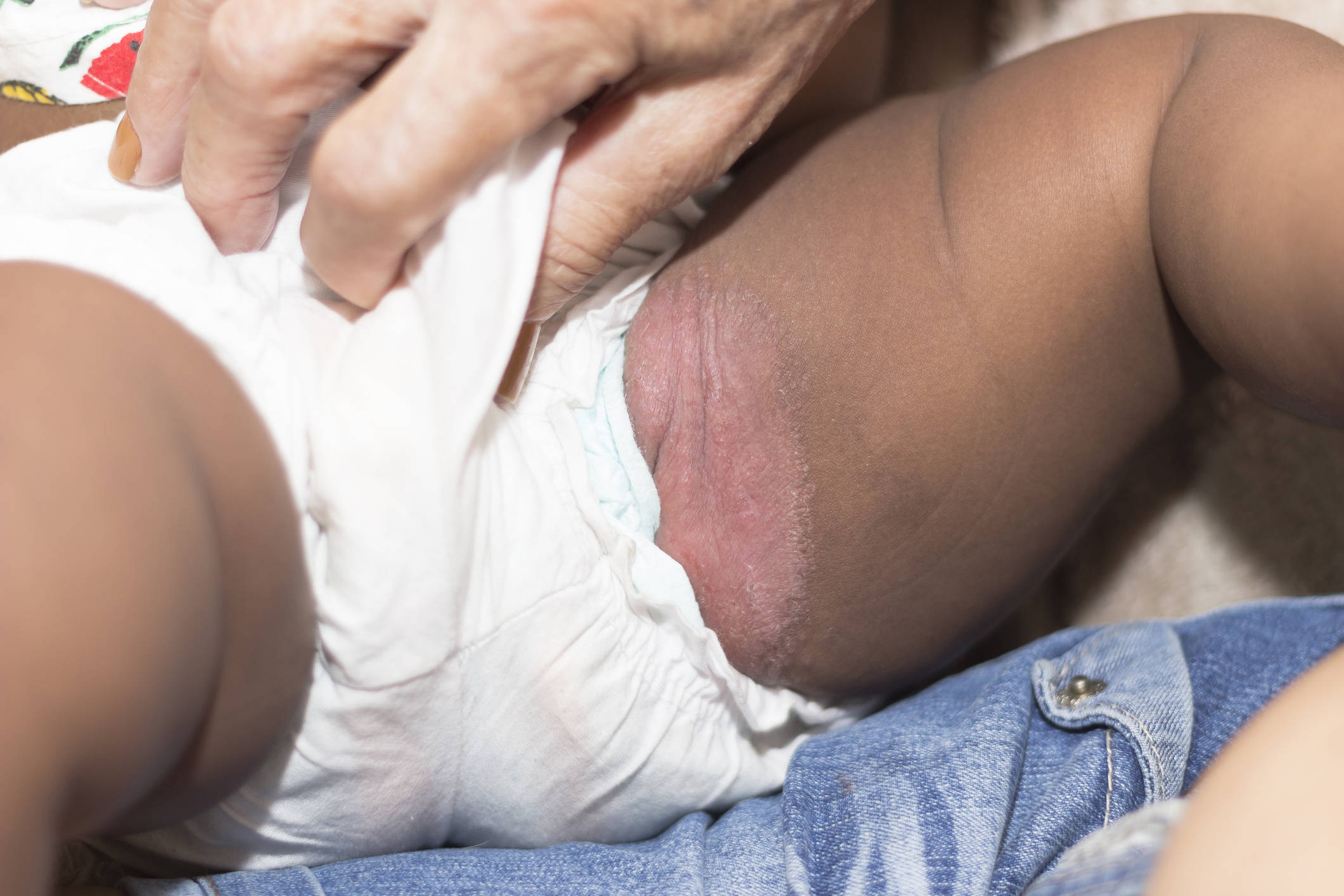
- Darker in colour
- Hot to the touch
- Scaly and dry, or possibly raw
- Itchy or painful, the baby appears uncomfortable or distressed
- Spotty or blistered
Nappy rash can happen when (NHS, 2023):
- Wet or dirty nappies are left on for a long time
- The nappy area isn’t well cleaned
- The nappy is tight and rubs the skin
- The skin becomes irritated by soaps or wipes containing fragrance or alcohol
- The baby has had medicine which makes the wee or poo more irritating
To prevent nappy rash (NHS, 2023):
- Change wet or dirty nappies as soon as possible. At night, a slightly wet nappy can be left, but a heavy or dirty nappy should be changed.
- Keep skin clean and dry. Leave the nappy off when possible.
- Make sure the nappy fits well.
- Avoid fragranced soaps, wipes and lotions.
To treat nappy rash (NHS, 2023):
- Take the nappy off as much as possible at home.
- For mild cases, a pharmacist can recommend a cream or medicine.
- If it doesn’t get better, and the baby seems distressed, see a health visitor or GP.
- A GP can prescribe a steroid cream, antifungal, or antibiotics when they have seen the baby.
Other common baby skin conditions
Baby acne
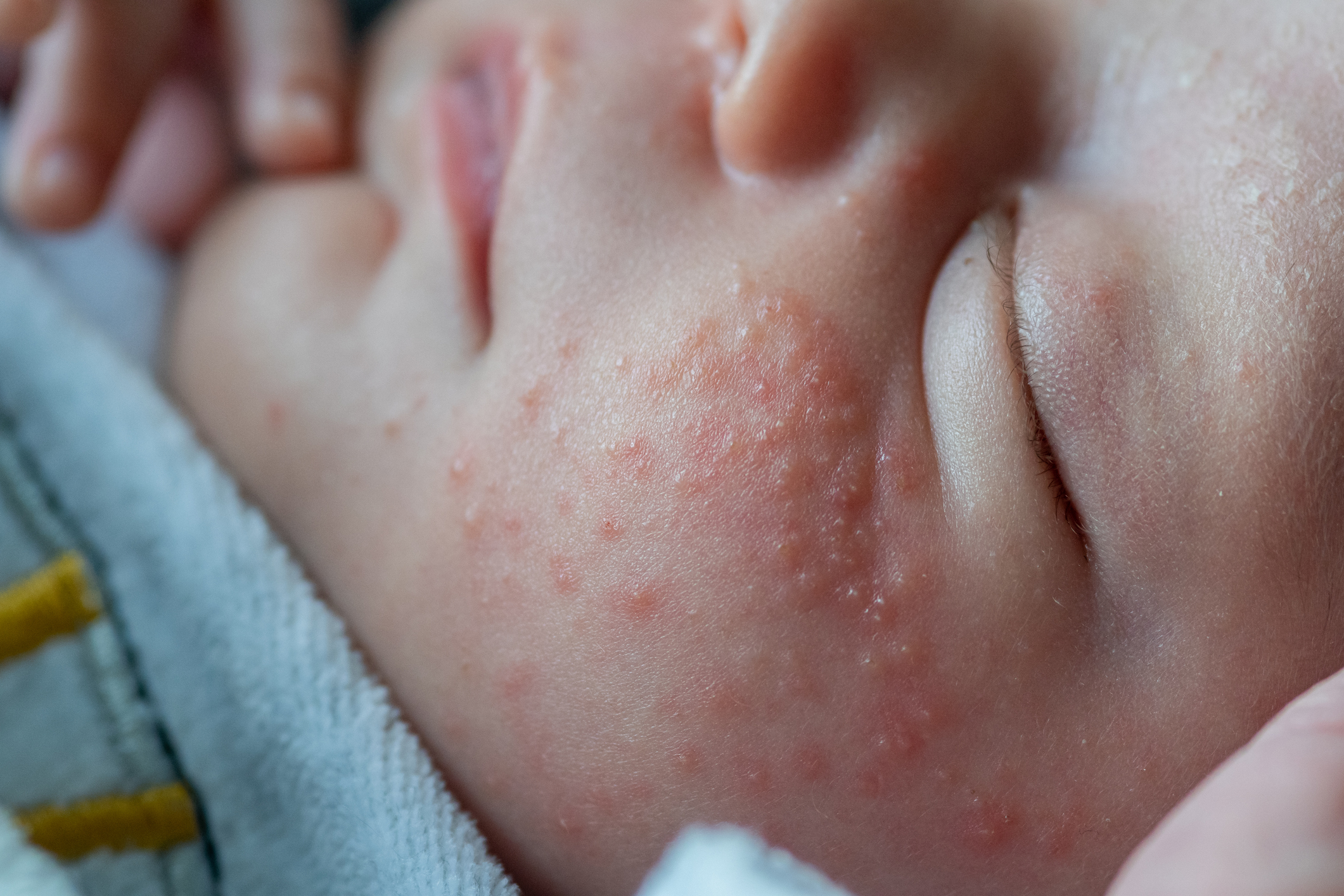
Pimples on a baby’s face or upper body that appear within the first six weeks of a baby’s life may be baby acne, or neonatal acne. This will clear up on its own after a few weeks and doesn’t need any treatment (NHS, 2024 b).
Cradle cap
Cradle cap usually appears as yellow or white, scaly or greasy patches on the baby’s scalp or face. It can also appear in the nappy area or where there are folds of skin. The skin under the crusts may look darker or lighter than the skin around it (NHS, 2024 b).
It does not spread between people and is not itchy or uncomfortable for the baby. The baby’s hair might come away with the scales, but there is no lasting effect. The only risk of infection is if the skin is broken when scales are picked (NHS, 2024 b).
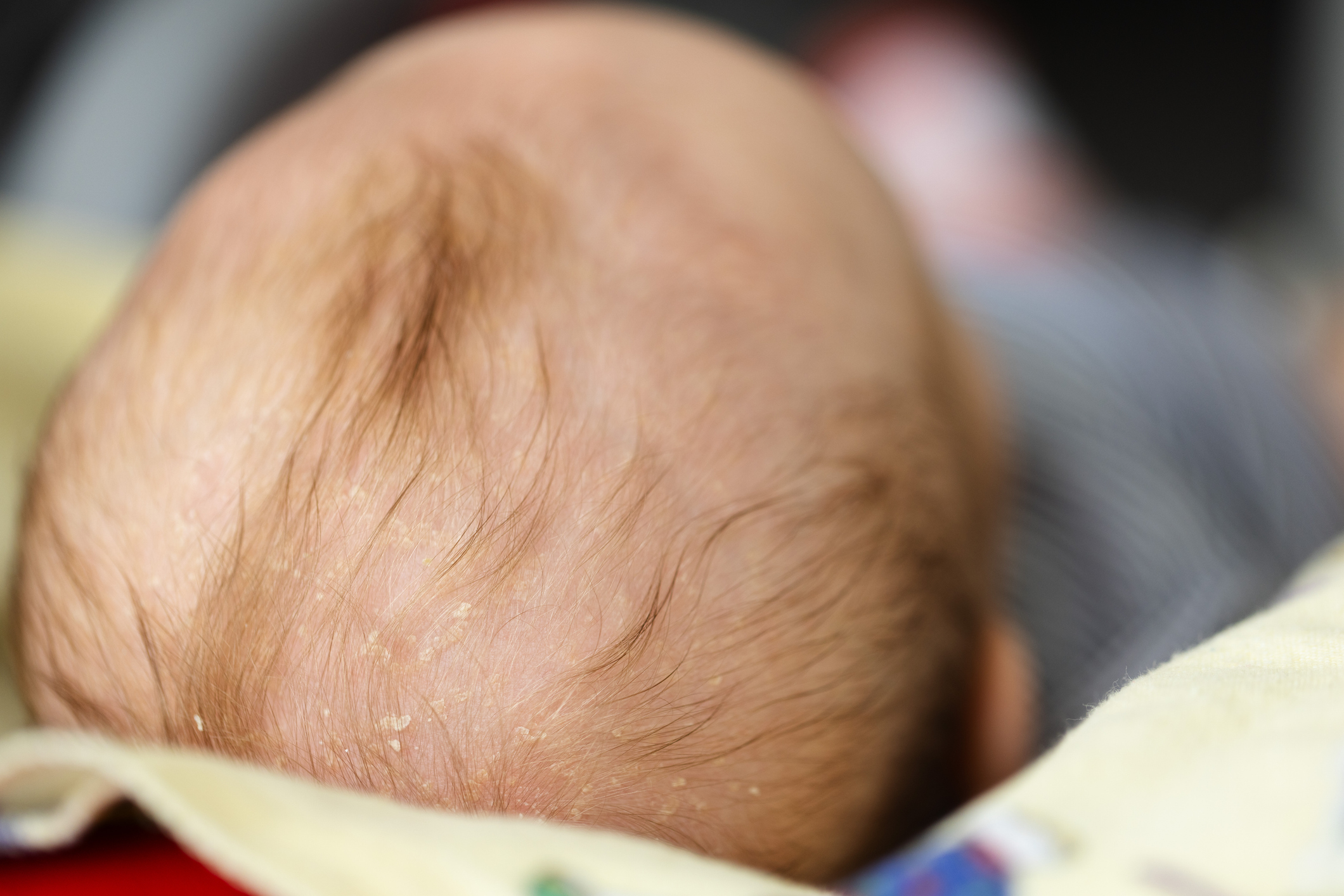
Mild cradle cap does not need to be treated, but if you want to reduce it (NHS, 2024 b; Noveir et al, 2024):
- Lightly massage the area with a moisturising cream or coconut oil
- Use a soft brush on the scalp and wash the affected area
- The pharmacy will have a suitable moisturising cream to use instead of soap.
- Don’t pick at the scales
Eczema [ex-ma]
Eczema is a condition that causes dry, itchy, cracked skin. It is common in children and often develops before they are a year old (Kelleher et al, 2022).
It most often appears behind the knees, elbows and neck. Speak to a GP if a child appears to have eczema (NHS, 2024 b).
Erythema toxicum [er-uh-THEE-muh toxi-cum]
This rash appears as red, yellow and white spots and is common on newborn babies. The spots appear on the face, body, arms and legs. The rash usually goes away completely in a few weeks (NHS, 2024 b).
Milia [mill-ee-ah]
Milia are very small white or yellow spots that appear on a baby’s nose or face when they are a few days old. They can also be inside the mouth or on the head or chest. Milia don’t need treatment and usually disappear in a few weeks (NHS, 2024 b).
Older children may get milia on their eyelids, forehead or nappy area. These spots can last longer than on newborn babies (NHS, 2024 b).
Kelleher MM, Phillips R, Brown SJ, Cro S, et al (2022) Skin care interventions in infants for preventing eczema and food allergy. Cochrane Database of Systematic Reviews. Issue 11. Art. No.: CD013534. https://doi.org/10.1002/14651858.CD013534.pub3
NHS (2023) Nappy rash. https://www.nhs.uk/baby/caring-for-a-newborn/nappy-rash/ [14 Apr 26]
NHS (2024 a) Your newborn baby. https://www.nhs.uk/pregnancy/labour-and-birth/getting-to-know-your-newb… [14 Apr 26]
NHS (2024 b) Rashes in babies and children. https://www.nhs.uk/symptoms/rashes-babies-and-children/ [14 Apr 26]
Noveir SD, Biba U, Galamgam J, Cheng CE (2024) A review of topical oils on the skin, JAAD Reviews, 2, pp 36-40. https://doi.org/10.1016/j.jdrv.2024.08.005
Rahma, A., & Lane, M. E. (2022). Skin Barrier Function in Infants: Update and Outlook. Pharmaceutics, 14(2)433. https://doi.org/10.3390/pharmaceutics14020433