What is a TENS machine?
TENS stands for Transcutaneous Electrical Nerve Stimulation.
A labour TENS machine is a hand-held, battery powered, device with four sticky pads, which are attached to the lower back (LabourPains, no date).
It usually has settings which can be increased from lower to higher, which provide small intermittent electrical pulses to the pads. This creates a tingling or scratchy sensation which is not usually painful at the lowest settings (LabourPains, no date; NHS, 2025).
A boost button provides a continuous current, which is used for the most intense part of the contraction. The device is controlled by the mother or birthing person, who can increase the intensity, and ‘boost’ when needed. It is possible to move around when using TENS.
How does a TENS machine work?
It is not well understood how a TENS machine might work. There are two theories (Dowswell et al, 2009; NHS, 2025):
- It interrupts pain messages to the brain (gate theory)
- It encourages the release of natural painkillers (endorphins)
Some research shows that women using it in labour are less likely to describe their pain as severe. However, the evidence that it reduces pain is not strong or consistent (Dowswell et al, 2009).
Some of the women who felt it was helpful were using a placebo (dummy) device. So it has been suggested that the TENS machine provides a distraction and sense of control (Dowswell et al, 2009).
Research has not been done on use in early labour at home (Dowswell et al, 2009).
Some people find that they simply don’t like using it. This might be the sensation, having wires attached to their back, or not finding it effective.
When and how do you use it?
The NHS recommend its use in early labour at home, particularly for backache. It is not routinely provided in hospital because of the lack of evidence that it is helpful in active labour (NHS, 2023).
How to use (NHS, 2025):
- Make sure the machine is off before fixing the pads
- Always start on the lowest setting, and build up gradually
- Turn up until a slight tingling is felt. It should not be painful
- As labour becomes more intense, increase the setting again, only until a slight tingling is felt
- Remove if moving into water, or it is no longer feeling effective
Can it be used with other pain management?
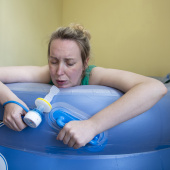
TENS is electrical so it shouldn’t be used in water, for example in a shower, the bath or a birth pool.
It is common to use some other form of pain management later in labour (LabourPains, no date). This might be Entonox, pethidine or diamorphine.
Can everyone use it?
A TENS machine is generally safe for most people to use. However, a GP or midwife can give advice on individual needs (NHS, 2025).
It shouldn’t be used if the mother or birthing person has epilepsy or uses a pacemaker (NHS, 2025).
Are there any side effects or long-term effects?
There are no negative effects for mother or baby during labour or afterwards (NHS, 2023; LabourPains, no date).
If the skin where the pads are stuck becomes irritated, turn off the device and remove the sticky pads. Don’t use on skin that is irritated or sore to begin with (NHS, 2025).
Can TENS affect labour or breastfeeding?
TENS does not seem to have an effect on the length of labour. It also does not affect whether the mother or birthing person will have interventions in labour, or the wellbeing of them or their babies (Dowswell et al, 2009).
There is no information that suggests TENS would affect breastfeeding.
Where can I get a TENS machine?
TENS machines are widely available to hire or buy. You can ask your midwife or pharmacy what is available locally (NHS, 2025).
It is a good idea to check the instructions before labour starts, and make sure the batteries are new and working. Make sure it is on the lowest setting before using.
How can a birth partner help with TENS?
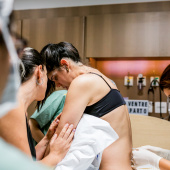
A woman or birthing person without a birth partner may find it hard to affix the sticky pads of a TENS machine.
A birth partner can put the sticky pads on the woman or birthing person’s back – a diagram is usually provided with a TENS machine.
The pads make it impossible to massage the back. The head, arms or legs can be massaged instead.
Dowswell T, Bedwell C, Lavender T, Neilson JP. (2009) Transcutaneous electrical nerve stimulation (TENS) for pain management in labour. Cochrane Database of Systematic Reviews, Issue 2. Art. No.: CD007214. https://doi.org/10.1002/14651858.CD007214.pub2
LabourPains (no date) TENS machine. https://www.labourpains.org/during-labour/tens-machine [19 Nov 25]
NHS (2023) Pain relief in labour. https://www.nhs.uk/pregnancy/labour-and-birth/pain-relief-in-labour/ [19 Nov 25]
NHS (2025) TENS (transcutaneous electrical nerve stimulation). https://www.nhs.uk/tests-and-treatments/transcutaneous-electrical-nerve… [19 Nov 25]