Why does labour hurt?
The uterus (womb) is made of three layers of muscle fibres, and during labour these contract. Muscles need oxygen, water and nutrition to work effectively, and can get tired. For most people the sensations of labour are of muscles working very hard.
Pain during labour is felt and expressed differently by everyone (LabourPains, no date a; NICE, 2023). Health professionals should respect the woman or birthing person’s choices for pain management (NICE, 2023).
What can make a difference to how labour feels?
Understanding what is happening
Our NCT Antenatal course can help explain what might happen during labour, so the pregnant woman or person feels more in control and confident (LabourPains, no date a).
During labour, a supportive midwife can build confidence and reduce fear.
Birth partners
A birth partner can make a huge difference to how the mother or birthing person feels during labour (LabourPains, no date a). Emotional support, like encouragement and reassurance from somebody they trust, can really boost confidence. It helps them cope with pain when they need it most.
Place of birth
Choosing where to give birth can also affect the experience of pain. If the mother or birthing person feels more relaxed in their environment, it can reduce anxiety (LabourPains, no date a).
For some this might mean giving birth at home. For others, it means giving birth in a hospital (LabourPains, no date a).
Induction
Having an induction to start labour can mean contractions feel more painful (LabourPains, no date a).
Self-help options for pain management
Some pain relief options are only available from a health professional, but others can be managed without medical support.
Breathing, relaxation, and visualisation – sometimes known as hypnobirthing
Relaxation, breathing and visualisation techniques can be effective coping strategies during labour and birth. Sometimes this is called hypnobirthing.
Breathing calmly improves the supply of oxygen to the uterus, helping it work effectively without cramping. For some women and birthing people, focusing on breathing can distract from the contractions (LabourPains, no date a). The baby benefits because their blood supply has plenty of oxygen.
During the first stage of labour, massage, breathing exercises or having a shower or bath are choices supported by health professionals for relieving pain (NICE, 2023).
Complementary therapies
Acupuncture, aromatherapy, reflexology, yoga and hypnotherapy are other forms of complementary medicine that women or birthing people choose for pain management. While they are not proven to provide effective pain relief, health professionals will support the decision to use them (NHS, 2023; NICE, 2023).
Water
Health professionals should also support the woman or birthing person’s choice to labour in water to help relieve pain (NICE, 2023).
Positions and movement in labour
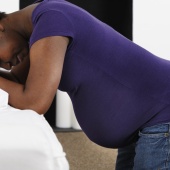
Most women or birthing people find that trying different positions and rocking, swaying or leaning forwards reduces pain and helps the baby to move through the pelvis.
A birth partner can help the labouring woman or person get into different positions. Movements can be very small shifts of weight or larger swaying, according to what feels good. As labour progresses, most women and birthing people use the time between contractions to rest and conserve energy.
TENS (Transcutaneous Electrical Nerve Stimulation) machine in labour
A TENS machine transmits mild electrical impulses to pads on the back. The theory is that these block pain signals or encourage the body to produce endorphins.
Pain management options that need a health professional
There is evidence to show that medical pain management can be effective, however these might have more adverse effects (Jones et al, 2012).
Women and birthing people with certain medical conditions can discuss pain management options with an anaesthetist. This conversation can happen before the labour and birth (LabourPains, no date b).
Epidural, spinal, and Combined Spinal Epidural (CSE)
Epidural, spinal and CSE are available on the labour ward or in the operating theatre in hospital.
They are injected into the space between two vertebrae in the back. They usually remove all or most feeling and pain from the waist down.
Gas and air, also known as Entonox
Entonox is a colourless, odourless gas made up of half nitrous oxide and half oxygen. The mother or pregnant person breathes gas and air through a mouthpiece.
General anaesthetic (GA)
General anaesthetic is a medicine that puts a person into a deep sleep. It is only used in an operating theatre. Read more in our article on caesarean birth.
Opioids - pethidine, diamorphine and remifentanil
Pethidine and diamorphine are pain relieving drugs given by a single injection into the thigh muscle.
Some hospitals offer remifentanil, which is also an opioid, but is given via a drip into a vein.
Sterile water injections
Sterile water injections involve putting a small amount of water into the skin of the lower back. Some people find they help with back pain during labour. They are not offered by all NHS Trusts.
Top Tips for labour
The following tips may be useful:
Before labour:
- Acknowledge that labour is unpredictable, and prepare with that in mind. It may help to write a birth plan.
- Some women and birthing people find it helps to spend some time imagining having the new baby in their arms after the birth and that everyone is well. Imagining that the birth went as they wanted can create a positive picture to focus on.
- Explore places, positions and movement during pregnancy.
During labour
- Distraction can help in the early stages.
- Movement helps labour to progress. Women and birthing people may find rocking and leaning forwards helps them manage. Others find hip-wriggling or stepping movements help the baby settle into a good position to be born.
- Allowing the out-breath to be longer than the in-breath can be calming.
- Some people find it helpful to make a noise. Moaning, grunting, sighing or swearing might help. Some women and birthing people have a word or phrase they find helpful to focus on.
- It can help to accept or welcome each contraction. As contractions become stronger, longer and closer together the body is getting ready to give birth.
- Save energy by focusing on relaxing any muscles that don’t need to be tense.
- Rest between contractions as labour progresses.
How others can help
- Having people around who help the woman or birthing person feel strong and capable can make a difference. Positive, affirmative, and supportive comments from birth partners help build confidence and belief in the ability to cope with the process.
- Warmth, massage or pressure on the sacrum (the lower part of the back down to the tailbone) might help. A warm water bottle or heat from hands could be enough. If in a birth pool, bath or shower, then water poured over the lower back can ease discomfort.
- Water can help women and birthing people relax and move more easily. Being in a pool can also create a sense of safety and security.
- Remember that the point at which labour feels worst – when the woman or birthing person feels they have had enough – is often the point just before they are ready to start pushing the baby out.
Disparities in pain management for Black and Brown women and birthing people
Research on the use of pain management in England has shown that Bangladeshi, Pakistani and Caribbean women and birthing people were less likely than their white counterparts to receive an epidural (Bamber et al, 2023; Craig et al, 2025).
Similarly, significantly more Black or Black British Caribbean, and Black or Black British African, women and birthing people received a general anaesthetic for a planned or unplanned caesarean birth than white British women (Bamber et al, 2023; Craig et al, 2025).
A general anaesthetic given for a planned caesarean birth is associated with poorer outcomes for the mothers or birthing people (Bamber et al, 2023; Craig et al, 2025).
While researchers could not pinpoint the reasons, they highlighted that as this research was in England, all the women and birthing people had access to the NHS. They described possible reasons for these differences as (Craig et al, 2025):
- Systemic racism
- Lack of access to care
- Socio-economic differences
- Education or cultural differences
- Mistrust of medical professionals
Effectiveness of pain management on those with red hair
Anaesthetists have noticed that people with red hair may need more pain relief than the general population (Williams and Pandit, 2023). They can have varied sensitivity to opioids, such as those that might be used during labour (Augustinsson et al, 2024).
Some have an increased tolerance to inhaled pain management such as gas and air. This might mean it doesn’t work as well. In which case, pain management given into a vein might be more effective (Augustinsson et al, 2024).
More information
LabourPains has information about pain management options for giving birth when a baby has died.
Read about the environmental impact of different kinds of pain management.
Augustinsson, A., Franze, E., Almqvist, M., Warrén Stomberg, M., Sjöberg, C., & Jildenstål, P. (2024). Red-Haired People’s Altered Responsiveness to Pain, Analgesics, and Hypnotics: Myth or Fact?—A Narrative Review. Journal of Personalized Medicine, 14(6), 583. https://doi.org/10.3390/jpm14060583
Bamber, J.H., Goldacre, R., Lucas, D.N., Quasim, S. and Knight, M. (2023), A national cohort study to investigate the association between ethnicity and the provision of care in obstetric anaesthesia in England between 2011 and 2021. Anaesthesia, 78: 820-829. https://doi.org/10.1111/anae.15987
Craig, R., El Nour, S., Xuereb, L.B., Gibbs, A., Suriyakumar, S., Blake, L., David, A.L., Lee, A., Nzelu, D., Moonesinghe, S.R., Bampoe, S., Carvalho, B., Kua, J. and O'Carroll, J.E. (2025), Racial and ethnic disparity in obstetric anaesthesia: a systematic review and meta-analysis. Anaesthesia, 80: 757-770. https://doi.org/10.1111/anae.16581
Jones L, Othman M, Dowswell T, Alfirevic Z, Gates S, Newburn M, Jordan S, Lavender T, Neilson JP. (2012) Pain management for women in labour: an overview of systematic reviews. Cochrane Database of Systematic Reviews, Issue 3. Art. No.: CD009234. https://doi.org/10.1002/14651858.CD009234.pub2
LabourPains (no date a) FAQs about labour. https://www.labourpains.org/during-labour/faqs-about-labour [4 Nov 25]
LabourPains (no date b) Anaesthetics for those with a raised BMI. https://www.labourpains.org/during-labour/anaesthetics-with-a-high-bmi [4 Nov 25]
NICE (2023) Intrapartum Care [NG235]. https://www.nice.org.uk/guidance/ng235 [4 Nov 25]