As with adults, babies and children are individuals. Some feel the cold while others don’t like being too warm. Over the first few months, parents will get to know their baby and what they want and need.
What clothes do you need for a newborn baby?
The NHS has a good checklist of all the items that might be needed for a new baby to use as a starting point.
For clothing, they suggest (NHS Best Start in Life, no date b; NHS, 2024 b):
- 6 all-in-ones, also called babygrows or sleepsuits – these have a body, long sleeves and legs (with or without feet)
- 4-6 vests or bodysuits with poppers that close over the nappy – these have a body with no arms or legs
- 2 lightweight cardigans in natural fibres
- Shawl or blanket
- Snow suit for colder weather
- Hat - wool or cotton for winter, or a wide brimmed sun hat
- Mittens for cold weather
- Socks, or bootees for colder weather
Many of these can be picked up at an NCT Nearly New Sale, which take place all across the UK – see if there’s one near you.
The size of the baby or babies won’t be known until they’re born, so this basic list is a good start. Baby clothes might be given as gifts after the birth.
Scratch mittens
Scratch mittens are sold as a way for the baby to stop scratching themselves during the day or night. However research into infant sleep discovered that babies with access to their hands during the night often sucked them, and this was linked to developing longer sleep periods (Owen et a, 2015).
How can I tell if my baby is the right temperature?
Bear in mind that babies are safer being cool than too hot, because overheating increases the chance of Sudden Infant Death Syndrome (SIDS) (Lullaby Trust, 2026).
Baby hands and feet often feel cold. Instead, feel their chest or the back of their neck to measure their temperature. If they feel hot or sweaty, remove a layer of clothing. If the body feels cold, add a layer of clothing (Lullaby Trust, 2026).
A baby that has hypothermia (has become dangerously cold) is cold to the touch, floppy or unusually quiet and sleepy. Call 999 or go to A&E if a baby is thought to have hypothermia (NHS, 2023).
If a baby shows signs of heatstroke get immediate medical help.
How to dress a baby in cold weather
Babies lose a lot of body heat because of their high surface-area to volume ratio. They cannot regulate their temperature or show they are cold by shivering (Lidell, 2019).
However, there is also a risk of babies overheating. It is better that the baby is slightly cool than too hot (NHS, Best Start in Life, no date a).
A helpful guideline is to dress them in one more layer than an adult would wear (NHS Best Start in Life, no date a). So indoors, on a cold day when the adult is wearing trousers, a long-sleeved top and jumper, the baby might need a vest, an all-in-one/sleepsuit and a cardigan.
To go outside, add a coat, snowsuit or blanket, and a hat, mittens and bootees.
Always take off hats and extra layers when indoors or in a warm car or public transport, as the baby is safer cooler than too hot. This is important even if it means waking them (NHS Best Start in Life, no date a).
Snow suits shouldn't be worn in a car seat as a lot of padding reduces the effectiveness of the safety straps. It may help to put the baby in a car seat indoors without a coat or snowsuit, and place a blanket over them while carrying them to and from a car. Take the blanket off when in the warm car.
Refusing to wear a coat
Older toddlers and young children often protest that they are too hot to wear a coat, even in cold weather. Children have a higher proportion of brown fat (adipose tissue) than adults do, which keeps them warm (Goodwin, 2025).
Children may also be trying to exert some control over their environment and their lives. Some children may have sensory sensitivities that make them dislike the feeling of wearing a coat (Goodwin, 2025; Walsh, 2017).
When reasonable (if the weather isn't too cold), take the coat just in case, but let them experience the natural consequences of their choice. This is known to be an effective parenting approach which helps children learn (Goodwin, 2025; Walsh, 2017).
Children with sensory sensitivities may prefer to have a choice in the fabric and style of the coat, or to compromise by wearing a vest or warm jumper instead (Goodwin, 2025). Pre-worn clothes, such as those from our NCT Nearly New Sales, are often more comfortable and less scratchy.
How to dress a baby in warm weather
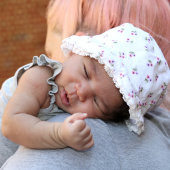
In hot weather, a baby often only needs a single layer of clothing. That might be an all-in-one, or a short-sleeved bodysuit. Choose lightweight cotton which is breathable (NHS, Best Start in Life, no date a).
Newborn baby’s skin shouldn't be exposed to the sun directly, and so they should be kept in the shade. After 6 months, a wide brimmed hat should be used when outdoors (NHS Best Start in Life, no date a).
Never cover the buggy with a muslin or blanket to shield the baby from the sun. It can make the air underneath very hot. Use a clip-on parasol or sunshade instead (NHS, 2024 a).
For more tips on how to keep them safe in the sun, see our article on Hot weather with a baby.
Usual weather in the UK
Currently, most days in the UK wouldn’t be classified as too hot or cold. In the early days, many parents apply the ‘one layer more than you’ guidance. As they get to know their baby better and understand when they feel the heat or cold, they can adjust the layers of clothing and covers.
More tips to consider:
- If the parent is out for a brisk walk with the baby in a buggy, the parent is likely to get warmer than the baby, who will need more layers.
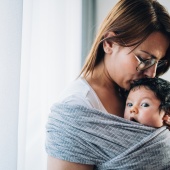
- A baby in a sling will receive body heat from the adult and so will need fewer layers. Read our article on slings and carriers.
How to dress a baby for naps or at night
At night or during naps, the ideal room temperature is between 16 and 20 °C. Babies can overheat if the room is too hot or they have too much clothing or bedding (NHS Best Start in Life, no date a).
Use the fewest layers possible to keep them warm (NHS, 2024 a; Lullaby Trust, 2026; NHS Best start in life, no date a):
- Clothing can be a sleepsuit or a short-sleeved bodysuit
- Bedding can be a lightweight cellular blanket or a baby sleeping bag that is snug enough so the baby can't slide down
- Avoid thick, fleecy or padded blankets, and remember that a folded blanket counts as two layers
The warmth of baby sleeping bags is measured in togs. When the room is warmer, the baby will need a lower tog sleeping bag or less bedding (Lullaby Trust, 2026). They can use a short-sleeved body suit rather than an all-in-one. If very hot, a vest or nappy only is fine (NHS, 2024 a).
Our article Sleep safety and co-sleeping has more information on room temperature, bedding and sleeping bag togs.
Other things to consider (NHS Best start in life, no date a; NHS, 2024 a, Lullaby Trust, 2026):
- If the baby feels cold, add an extra layer of clothing. Don’t put a blanket over the sleeping bag.
- If the baby feels hot, take away a layer of bedding.
- If bed-sharing, a baby sleeping bag is better than the parent’s bedding.
Check when it’s safe to swaddle a baby.
Footwear for babies and children
Babies don’t need proper shoes until they are walking on their own, and then they’ll only need them when they’re walking outside (NHS, 2022).
Walking barefoot can help develop balance and build muscles and co-ordination. Safe surfaces outside include grass or sand, although sand can become very hot in sunny weather (Institute of Podiatrists, no date; The College of Foot Health, no date).
Keep an eye on all-in-ones to make sure they are not becoming restrictive on the foot as the baby grows. If they do, change them for a larger size straight away, or cut off the toe part of the all-in-one (The College of Foot Health, no date).
When choosing shoes:
- Go to a trusted shoe shop where they should be happy to measure the baby or child’s feet at any time. They can advise if new shoes are needed, and on the correct size and style (The College of Foot Health, no date). Check this searchable list of shops with trained shoe fitters.
- Shoes with laces, a buckle or velcro fastening can keep the foot in place and stop it slipping forwards (NHS, 2022).
- Shoes should fit well at the heel, with no slipping, and have room to wiggle the toes. But they are too big if they slip off the heel when the baby or child is standing tip toe (Institute of Podiatrists, no date; NHS, 2022).
- Baby’s and young children’s feet grow quickly. Check the shoe size every 6-8 weeks by putting a hand inside the shoe to check that the toe indentation is not too near the top of the shoe (Institute of Podiatrists, no date).
- Natural, lightweight materials like leather let feet breathe and don’t restrict movement or growth (Institute of Podiatrists, no date).
- Shoes can be expensive and children often quickly grow out of them. However, because leather shoes mould to the individual foot they should not be passed down or bought second hand. The College of Foot Health says that wearing a shoe which has moulded to another foot can cause harm (The College of Foot Health, no date).
Further information
We also have a downloadable guide to dressing a baby.
The NHS has a video on choosing your child’s first shoes.
Goodwin C (2025) The Research Behind Why Your Child Won't Wear a Coat. https://parentingtranslator.substack.com/p/the-research-behind-why-your… [1 Jun 26]
Institute of Podiatrists (no date) Children’s foot health: a guide for parents. https://www.iop-uk.org/footcare/childrens-foot-health-a-guide-for-paren… [1 Jun 26]
Lidell ME. (2019) Brown Adipose Tissue in Human Infants. Handb Exp Pharmacol. 251:107-123. https://doi.org/10.1007/164_2018_118
Lullaby Trust (2026) How to dress your baby for sleep. https://www.lullabytrust.org.uk/baby-safety/baby-product-information/dr… [29 May 26]
NHS (2022) Leg and foot problems in children. https://www.nhs.uk/baby/health/leg-and-foot-problems-in-children/ [1 Jun 26]
NHS (2023) Hypothermia. https://www.nhs.uk/conditions/hypothermia/ [29 May 26]
NHS (2024 a) Keeping your baby safe in the sun. https://www.nhs.uk/baby/first-aid-and-safety/safety/safety-in-the-sun/ [29 May 26]
NHS (2024 b) What you’ll need for your baby. https://www.nhs.uk/baby/caring-for-a-newborn/what-you-will-need-for-you… [29 May 26]
NHS Best Start in Life (no date a) How to dress a newborn baby. https://www.nhs.uk/best-start-in-life/baby/baby-basics/caring-for-your-… [29 May 26]
NHS Best start in life (no date b) What to buy for your newborn baby. https://www.nhs.uk/best-start-in-life/pregnancy/preparing-for-labour-an… [29 May 26]
Owen, C., Hovish, K., Roberts, M., & St James-Roberts, I. (2015). Video Evidence That London Infants Can Resettle Themselves Back to Sleep After Waking in the Night, as well as Sleep for Long Periods, by 3 Months of Age. Journal of Developmental & Behavioral Pediatrics, 36(5), 324–329. https://doi.org/10.1097/DBP.0000000000000166
The College of Foot Health (no date) Foot care for babies and small children. https://cofh.org.uk/footcare-advice-old__trashed/foot-care-babies-small… [1 Jun 26]
Walsh B (2017) Put your coat on! https://www.gse.harvard.edu/ideas/usable-knowledge/17/12/put-your-coat [1 Jun 26]