What is constipation?
Constipation in babies or toddlers is when they have trouble passing a poo, or faeces [fee-sees]. A normal poo is (Bladder & Bowel UK, no date a):
- Soft
- Easy to pass
- Brown or dark green
Constipation happens when the body doesn’t respond to the message that food has travelled through the stomach and bowel and is ready to be passed out of the body. The poo stays where it is as new messages aren’t sent to the brain to move the poo. More food arrives in the bowel as poo and it begins to build up (ERIC, 2026).
When constipated, poo becomes hard and difficult to pass. The longer this continues, the larger and harder the poo will become and it can become uncomfortable or painful to pass. This might make the baby or child afraid to pass the poo, and the cycle can go on for longer (Bladder & Bowel UK, no date a).
Our Newborn baby poo in nappies page has information on what to expect in a baby’s nappy for the first few weeks.
How do I know if my baby is constipated?
Constipation in babies and children is common. However, it can be difficult to spot, especially if they haven’t started potty training (Bladder & Bowel UK, no date b).
If two or more of these signs are present then the baby may be constipated (Bladder & Bowel UK, no date a; ERIC, 2026; NHS, 2023):
- Pooing less than three times a week
- More than three times a day (when the baby is past the very early days – see our article on newborn poo in nappies)
- Soiling the nappy or pants – runny poos may be liquid poo being pushed past the solid faeces
- A sore bottom, or bleeding during or after passing a hard poo
- Pain in the tummy or bottom when doing a poo
- A swollen tummy
- Passing a large, hard poo
- Avoiding pooing
- Not wanting to eat, which may improve after a poo
- Wetting during the day or night, if a full rectum is pressing on the bladder (although wetting is not always a sign of constipation)
What is faecal impaction and how is it different from constipation?
Constipated babies may pass large, hard poos infrequently (as well as some soiling and skid marks), but they tend to be clean between poos.
Babies and toddlers with faecal [fee-kal] impaction may not be able to pass any formed poos at all (Bladder & Bowel UK, no date a):
- The message to the brain that the body needs to do a poo becomes weaker, until the feeling of needing to do a poo can go away.
- However, the process to create the poo continues, and it builds up in the rectum.
- There may be small poos like ‘rabbit droppings.’
- Or watery or loose poo (overflow soiling), sometimes with small hard bits where pieces of the solid poo have broken off.
- The loose poo and wind may be very smelly.
- The child is unaware this is happening and not able to control it.
- Faecal impaction needs different treatment from constipation.
Is there a difference in poo if a baby is formula-fed or breastfed?
While there is a lot of variation between babies, those who are fed breast milk tend to have softer poos which they pass more often than formula-fed babies. But all baby poos should be soft until they start to eat solid food, when the poos become firmer (Bladder & Bowel UK, no date b).
How firm or soft a baby’s poo is, and how often they poo, can indicate whether they are constipated or not. As babies get older, it takes longer for the poo to pass through their body so they will poo less often as they grow (Bladder & Bowel UK, no date b).
What causes constipation in babies?
A baby might be constipated for several reasons, although the reason might never be known. Possible reasons include (Bladder & Bowel UK, no date b; NHS, 2023):
- Making a powdered formula milk feed without enough water. Read our article on how to make up a feed or speak to a health visitor.
- Introducing solid foods without enough water-based drinks or fruits and vegetables.
- Dehydration following illness with a high temperature, vomiting or diarrhoea.
- Being regularly interrupted or feeling pressured during potty training.
- In older children, anxiety about moving house, a new baby, or starting nursery or school
- High dairy (cow’s milk) intake can affect some babies and toddlers. Talk to a health visitor before changing a baby’s milk or diet.
My baby seems upset or in pain when they poo
Some babies wriggle, appear to struggle, go red in the face or seem to be straining when they do a poo. They may cry or seem to be unsettled. This is called infant dyschezia [dis-KEE-zee-uh] (Bladder & Bowel UK, no date b).
It’s not constipation if the poos appear to be soft and come out easily, and the baby doesn’t remain uncomfortable or upset. They may simply not have learnt how to relax their pelvic floor when doing a poo (Bladder & Bowel UK, no date b).
Babies often stretch out their legs when they need to do a poo, but this can stop the pelvic floor from relaxing. Parents can help by bending the baby’s legs into a squatting position (Bladder & Bowel UK, no date b).
Ask the health visitor if concerned.
What should I do if my baby or toddler is constipated?
Keep a record of their poo for two weeks, like this this poo diary. Make a note of how much they poo and what it looks like. After two weeks, take this record to the GP (ERIC, 2026).
The GP will examine them and ask questions to find out if the constipation is caused by an underlying health condition (ERIC, 2026).
The doctor may suggest trying laxatives to treat it. These are a safe medicine to use for babies and children when used on the advice of a medical professional (Bladder & Bowel UK, no date b; NHS, 2023).
Parents may be concerned about treating constipation with laxatives. However, leaving constipation untreated can mean the problem becomes worse and results in chronic constipation or impaction (Bladder & Bowel UK, no date a; Bladder & Bowel UK, no date b).
Laxatives may take a few months to work and may need to be continued for a while afterwards to make sure the poo remains soft enough to be passed easily (NHS, 2023).
Tips to prevent constipation
For younger babies (ERIC, 2026; NHS, 2023; Bladder & Bowel UK, no date b):
- Give the baby plenty of milk or water-based drinks each day. Offer breastfed babies frequent feeds.
- If formula feeding, follow the manufacturer’s instructions on the correct amount of water to use. Babies can have extra sips of water between formula feeds if necessary. Under six months this must be cooled boiled water.
- If over six months and eating solid foods, include fruit and vegetables. Diluted fruit juice may be recommended by a health visitor.
- Encourage them to be active and move around.
- Stay calm to avoid the baby or child picking up anxiety about them using the potty or toilet.
- Some parents find cycling the legs, or a warm bath, can help.
- Abdominal massage can be taught by a qualified professional.
If the baby or toddler is potty trained, it can help to put them on the potty 20-30 minutes after meals and before and after sleeping (ERIC, 2026; NHS, 2023).
Encourage them to sit on the potty or toilet with their feet flat with their knees higher than their hips. If using a toilet they will need a box or stool to rest their feet on, and a child toilet seat. Having toys to hand can help them relax and stay sitting in the same place (ERIC, 2026; NHS, 2023).
Ask them if they’re anxious about anything such as nursery or school. Remain calm and reassuring so they don’t pick up on any stress (NHS, 2023).
Further information
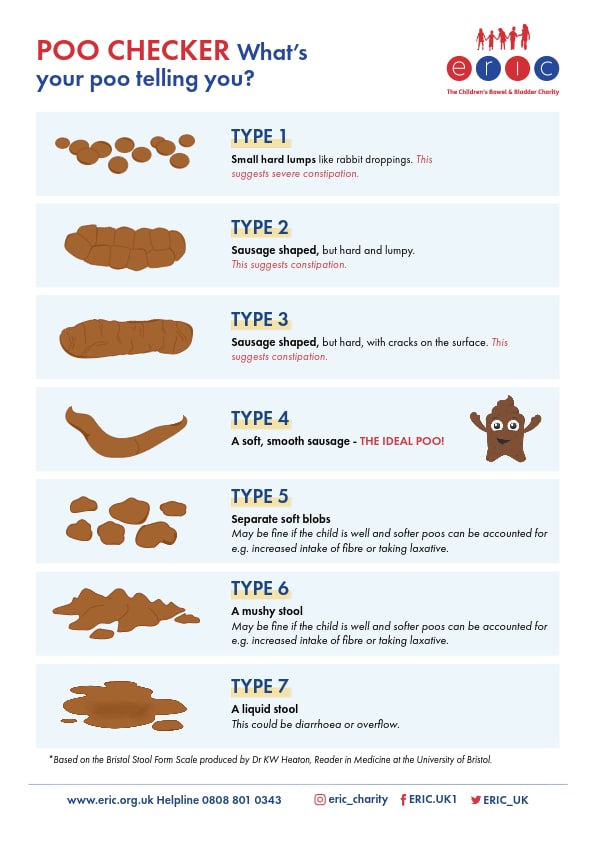
The Bristol Stool chart has handy pictures to show what poo should look like and what might suggest they are constipated.
The children’s bowel and bladder charity, ERIC, has information about constipation in several languages.
Bladder & Bowel UK (no date a) Children information library. https://www.bbuk.org.uk/children-young-people/resources-for-children/ [27 May 26]
Bladder & Bowel UK (no date b) Understanding constipation in babies and toddlers. Available at: https://www.bbuk.org.uk/children-young-people/resources-for-children/ [27 May 26]
ERIC (2026) Advice for children with constipation. https://eric.org.uk/advice-for-children-with-constipation/ [27 May 26]
NHS (2023) Constipation in children. https://www.nhs.uk/baby/health/constipation-in-children/ [27 May 26]