What is flat head syndrome?
When babies are a few months old, parents sometimes notice they have a flattened head. Until they’re about one, the bones of a baby’s head are very thin and flexible. This makes them soft and easy to mould (NHS, 2026).
Some babies are born with a flat head due to their position in the womb. For others, flat head syndrome develops when pressure is placed on one part of the baby’s skull after birth (NHS, 2026).
That’s usually because they spend a lot of time lying on their backs or with their head turned to one side when they’re newborn (NHS, 2026).
Flat head syndrome does not affect the brain or development (NHS, 2026).
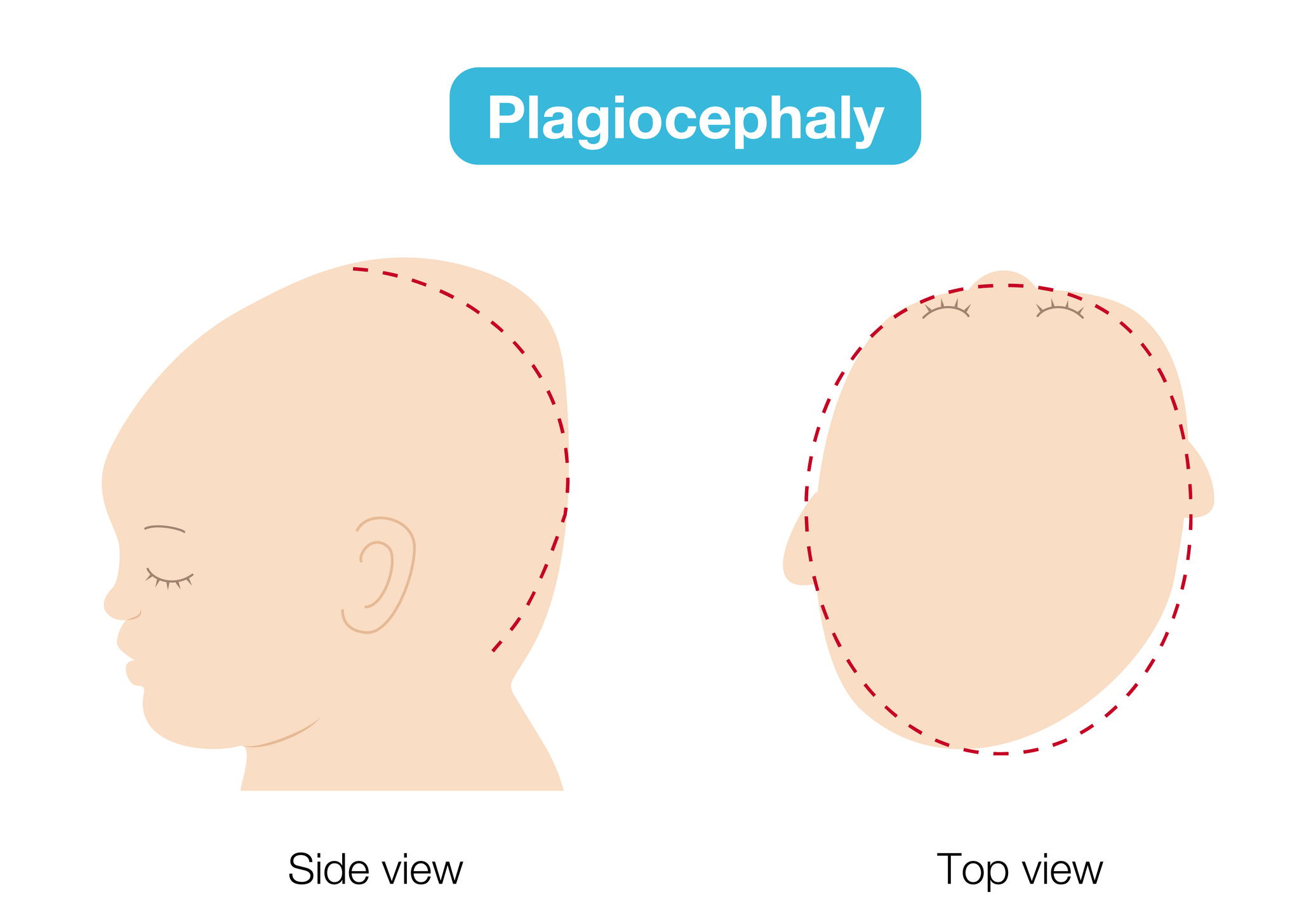
Plagiocephaly [play-jee-oh-SEF-uh-lee]
The baby’s head is flattened on one side, so it looks asymmetric. The ears may not line up when seen from above (NHS, 2026).
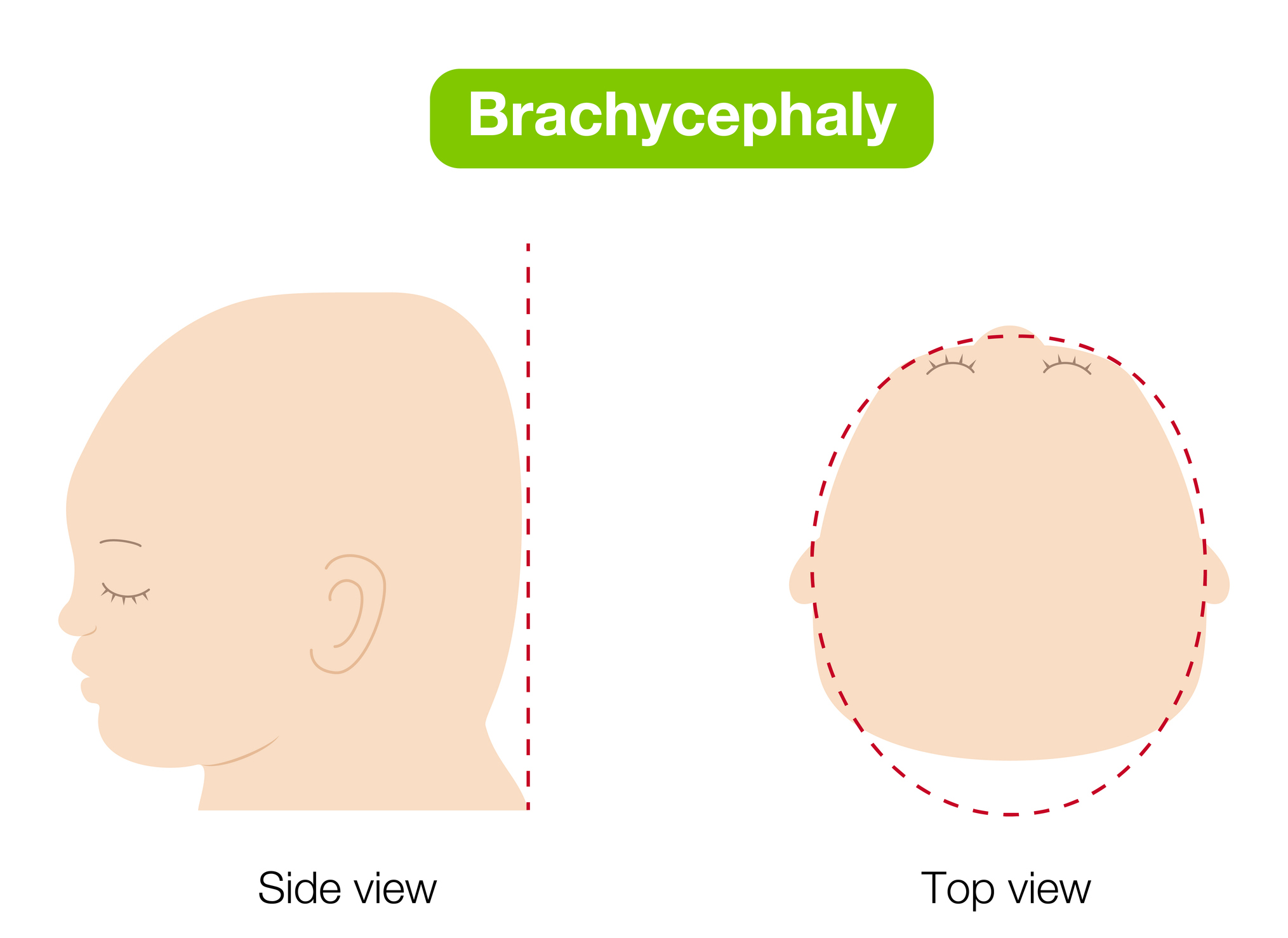
Brachycephaly [brak-ee-SEF-uh-lee]
The back of the baby’s head becomes flattened, causing the head to widen, and occasionally the forehead bulges out (NHS, 2026).
Craniosynostosis [kray-nee-oh-sy-nuh-STOH-sis]
Occasionally a flat head at birth is not flat head syndrome but a more serious condition.
A GP can help decide if tests are needed to rule out craniosynostosis. This is a rare condition where the plates of the skull have fused together too early (NHS, 2023).
For some babies craniosynostosis may be linked to learning difficulties or physical conditions. The condition will be monitored, and surgery may be recommended to reduce these effects (NHS, 2023).
What are the signs of flat head syndrome?
Other than physical appearance, there are no signs of plagiocephaly or brachycephaly (NHS, 2026).
Check the baby’s head regularly. The earlier flat head syndrome is noticed, the sooner steps can be taken to prevent it getting worse (NHS, 2026).
See the GP if concerned about the shape of a baby’s head, or if they have trouble turning their head to one side (NHS, 2026).
Why do babies develop a flat head?
Pressure on the baby’s head in the womb
The position in the womb or a difficult labour can cause the baby’s head to become flattened in one area. Newborn heads are not always round after birth, but this usually improves within a few weeks (Association of Paediatric Chartered Physiotherapists, 2026).
Tight neck muscles (torticollis)
Tight neck muscles can stop a baby turning their head in a particular way. This can mean the baby always rests their head on the same side (Association of Paediatric Chartered Physiotherapists, 2026; NHS, 2026).
Torticollis is usually noticed within a month of birth and may be caused by the baby’s position within the womb, or birth trauma (NHS Scotland, 2018).
It may be linked to difficulty breastfeeding on one side because the baby struggles to have a good latch (Genna, 2015). Our NCT Breastfeeding counsellors offer support with feeding challenges.
Babies born prematurely
Premature babies are more likely to develop a flattened head because their skulls are softer than those of full-term babies. It may not be possible to move or pick up premature babies as often, and they may not yet be able to move their head from side to side (Association of Paediatric Chartered Physiotherapists, 2026; NHS, 2026).
Babies spend a lot of time on their backs
Putting a baby to sleep on their back greatly reduces the risk of Sudden Infant Death Syndrome (SIDS). So, it’s common for babies to spend a lot of their early lives lying on their backs. The protection of sleeping on their back far outweighs the possibility of head flattening (NHS, 2026; The Lullaby Trust, 2025).
Babies may also spend a lot of time in one position in car seats, buggies, and on the floor, which can contribute to a flat head (NHS, 2026; Association of Paediatric Chartered Physiotherapists, 2026).
Do plagiocephaly and brachycephaly need treatment?
In most cases, babies won’t need any treatment. The flattening will get better over the first couple of years as they spend less time on their back (NHS, 2026).
But some actions by parents and carers can help:
Tummy time
Give the baby time on their tummy a few times each day. Only do tummy time when the baby is awake and alert, and when an adult caregiver is there to keep an eye on them (NHS, 2026; The Lullaby Trust, 2025). Tummy time can also be in contact with a parent, for example lying on their chest, or being carried in a sling.
When the baby has good head control and is beginning to sit, put them in a seated position on the floor for short, supervised periods (Association of Paediatric Chartered Physiotherapists, 2026).
Adjust their head position during sleep
Gently reposition the baby’s head to the other side after they have fallen asleep. Swapping ends of the cot each night takes advantage of the fact they may prefer to look towards the parent, or away from a wall (Association of Paediatric Chartered Physiotherapists, 2026).
Using any kind of pillow is not a safe way to prevent or treat head flattening (The Lullaby Trust, 2025).
Change the position of toys, mobiles and lights
When they’re awake, put anything interesting or exciting on different sides to encourage the baby to turn their head (Association of Paediatric Chartered Physiotherapists, 2026; NHS, 2026).
Varying positions when feeding and carrying
Alternate the side the baby is held when fed and carried. Use a sling or carrier as well as a buggy (Association of Paediatric Chartered Physiotherapists, 2026; NHS, 2026).
Car seats and buggies can be harder than the baby’s normal sleep surface so only use them for journeys and always take them out after arriving at the destination. Move the car seat so the baby turns their head a different way to look out of the window (Association of Paediatric Chartered Physiotherapists, 2026; NHS, 2026; The Lullaby Trust, 2025).
Physiotherapy
For babies who have trouble turning their head, physiotherapy can be very helpful. Ask for referral to a physiotherapist, who will be able to suggest gentle exercises to try with the baby (Association of Paediatric Chartered Physiotherapists, 2026; NHS, 2026).
What about other interventions?
Other treatments such as cranial osteopathy and helmets or headbands are available. However flat head syndrome usually resolves within a year and there is no strong evidence that these treatments are more effective than the simple interventions mentioned above.
Flat head syndrome and babies’ future development
Some researchers have suggested flat head syndrome may be linked to developmental delays for the child. However, this is not supported by the NHS (NHS, 2026).
Most cases resolve by the time the child is two, though a small amount of flattening may remain (NHS, 2026).
Association of Paediatric Chartered Physiotherapists (2026) APCP Head Turning Preference and Plagiocephaly (Head Flattening): Information for parents and carers. Available from: https://apcp.csp.org.uk/publications/apcp-head-turning-preference-plagi… [3 Aug 26]
Genna CW. (2015) Breastfeeding infants with congenital torticollis. J Hum Lact. May;31(2):216-20. https://doi.org/10.1177/0890334414568315
King HH., Mai J, Morelli Haskell MA, Wolf K, Sweeney M. (2024) "Effects of osteopathic manipulative treatment on children with plagiocephaly in the context of current pediatric practice: a retrospective chart review study" Journal of Osteopathic Medicine, vol. 124, no. 4, pp. 171-177. https://doi.org/10.1515/jom-2023-0168
NHS (2023) Craniosynostosis. https://www.nhs.uk/conditions/craniosynostosis/ [3 Aug 26]
NHS. (2026) Flat head syndrome (plagiocephaly and brachycephaly). https://www.nhs.uk/conditions/flat-head-syndrome-plagiocephaly-brachyce… [3 Aug 26]
NHS Scotland (2018) Torticollis (Congenital and acquired) Children, Emergency Department, Paediatrics (365). https://www.rightdecisions.scot.nhs.uk/shared-content/ggc-clinical-guid… [15 Sep 26]
Panza, R., Piarulli, F., Rizzo, V. et al. (2024) Positional plagiocephaly: results of the osteopathic treatment of 424 infants. An observational retrospective cohort study. Ital J Pediatr 50, 166. https://doi.org/10.1186/s13052-024-01729-3
The Lullaby Trust (2025) Baby mattresses and bedding. https://www.lullabytrust.org.uk/baby-safety/baby-product-information/ma… [3 Aug 26]