What is a sterile water injection?
Sterile water injections are also known as sterile water blocks. They are used to manage back pain in labour or ‘back labour’ by injecting medical-grade sterile water just under the skin on the lower back. Current evidence does not support their use to help the pain of contractions (NICE, 2023).
What is back labour?
During labour, most women and birthing people experience contractions that come and go, with breaks in between. Around one in three experience constant lower back pain, as well as contractions (Wickham, 2024).
By reducing back pain, sterile water injections can give women and birthing people some rest and help them better cope with labour pain (Oxford University Hospital Trust, 2024).
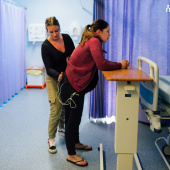
A woman or birthing person may also want to try moving into different positions during labour. For example, kneeling or getting on all fours might help to ease back pain and encourage the baby to move.
Who can have a sterile water injection?
Any woman or birthing person can request a sterile water injection if they are experiencing back pain during labour. However, they are not available across the whole UK.
Where can you get a sterile water injection?
In theory, it would be possible to use sterile water injections in all birth settings, including hospital labour wards, midwife-led units, and when giving birth at home (Lee et al, 2020; NICE, 2023).
However, they must be given by a trained midwife (NICE, 2023), and not all NHS Trusts offer sterile water injections, so it’s a good idea to ask about availability during pregnancy.
How are sterile water injections given?
Injections are given in four precise locations just under the skin on the lower back (NICE, 2023; Wickham, 2024).
They may be given during a contraction to distract from the sting. Gas and air (Entonox) can also be used at this time if needed.
Injections can be repeated as needed (Oxford University Hospital Trust, 2024).
How do the sterile water injections work?
Sterile water injections create a strong stinging sensation (NICE, 2023). It is believed this triggers the body’s natural pain-relieving hormones (endorphins) (NICE 2023; Oxford University Hospital Trust, 2024).
While contraction pain continues to come and go, back pain may be eased.
Are sterile water injections effective?
Research suggests sterile water injections may help to reduce back pain during labour by up to half for the women and birthing people who use them (Lee et al, 2020).
The effect may start within 10 minutes, and relief can last up to three hours. However, because the evidence was not strong, sterile water injections are only recommended for back pain during labour (NICE, 2023).
Women and birthing people who used the injections described being able to use the period of relief to rest or focus more on their birth experience (Lee et al, 2017).
Recent research suggests sterile water injections in the abdomen may also help reduce contraction pain for up to 60 minutes (Lee et al, 2026), but this is a new area of study and not yet offered in UK maternity services.
What are the benefits of Sterile Water Injections?
In addition to easing back pain, sterile water injections (Oxford University Hospital Trust, 2024; Wickham, 2024; NICE, 2023):
- Often work immediately
- Don’t affect alertness or awareness
- Have no side effects for the baby
- Don’t cause allergic reactions
- Can be repeated as much as needed
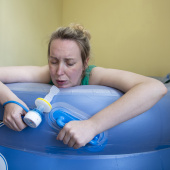
- Can be used with other pain management options, including water birth
- Don’t affect movement, pushing, or feeling sensations during birth
- Are suitable in all birth settings (though may not be available)
- Require no additional monitoring
- Do not increase the chance of unplanned caesarean birth, vaginal birth with forceps or ventouse, or neonatal unit admission.
Are there any side effects?
- There is an intense stinging sensation for 30-90 seconds from the time of the injection (Wickham, 2024; NICE, 2023)
- As with any injection, there is a small chance of infection or inflammation where the injection is given, though no cases have been recorded in research studies (NICE, 2023; Wickham, 2024).
Other things to consider before using sterile water injections
- They are not guaranteed to work
- The robust evidence is to relieve back pain, not contraction pain (NICE, 2023).
- They must be given by a trained professional
- They are not available in every NHS Trust or Board.
- Expectant parents who would be interested in this option if they were experiencing back pain in labour should ask the midwife during pregnancy if sterile water injections are offered at their NHS Trust or Board.
What other pain management options are available?
To learn about other pain management options read our articles on:
- Using a TENS machine
- Gas and air (Entonox)
- Water
- Epidurals
- Intramuscular opioids (Pethidine/ Diamorphine)
- Remifentanil
Need more information?
Every woman and birthing person has the right to feel safe, informed, supported, and confident about their decisions.
For further information, we offer NCT antenatal courses which are a great way to prepare for pregnancy, birth, and life with a new baby.
Our NCT support line also offers practical and emotional support with feeding your baby and general enquiries for parents, members and volunteers: 0300 330 0700.
Lee N, Kildea S, Stapleton H (2017) “No pain, no gain”: The experience of women using sterile water injections. Women and Birth, 30(2) pp153-158. https://doi.org/10.1016/j.wombi.2016.09.010
Lee, N; Martensson, LB et al (2026) Sterile water injections for managing abdominal labour contraction pain: A randomised double blind placebo-controlled trial International Journal of Nursing Studies, 173. https://doi.org/10.1016/j.ijnurstu.2025.105244
Lee, N; Gao, Y et al (2020) Caesarean delivery rates and analgesia effectiveness following injections of sterile water for back pain in labour: A multicentre, randomised placebo controlled trial. eClinicalMedicine, 25. https://www.thelancet.com/journals/eclinm/article/PIIS2589-5370(20)30191-7/fulltext [20 Oct 25]
NICE (2023) Intrapartum Care [NG235]. https://www.nice.org.uk/guidance/ng235/ [21 Oct 25]
Oxford University Hospital Trust (2024) Sterile water injections for back pain relief in labour: Information sheet. Available from: https://www.ouh.nhs.uk/patient-guide/leaflets/ [21 Oct 25]
Wickham, S (2024) Sterile water injections: what’s the evidence? https://www.sarawickham.com/articles-2/sterile-water-injections/ [20 Oct 25]