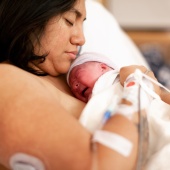
Recovery for the mother or birthing person should be prioritised, and they can ask for help or accept offers of help. Call the GP or midwife if after any birth there is (NICE, 2021a):
- Heavy or sudden vaginal bleeding
- Severe pain in the tummy or pelvis, fever or shivering, or vaginal discharge with an unpleasant smell, which could indicate a retained placenta
- Swelling or tenderness in the legs, which might be caused by thrombosis
- Chest pain, which could be thrombosis or heart problems
- Severe headache, which could be pre-eclampsia
- Swelling or pain in the breasts which doesn’t ease after a feed, or painful lumps in the breast (these could be signs of mastitis)
Vaginal birth
After a straightforward vaginal birth, the mother or birthing person may be discharged from care within a few hours, or may be in hospital for a few days or longer.
Care and recovery after tearing or episiotomy
During vaginal birth, some women and birthing people experience grazing, tearing or episiotomy (a cut made by a health professional to reduce the chance of more significant damage).
Stitches are normally done within an hour after birth to repair a tear or episiotomy. A local anaesthetic is given to manage the pain. These are dissolvable, so it won’t be necessary to go back to hospital to have them taken out.
Call the GP or midwife if signs of infection develop (NHS, 2023a; RCOG, no date):
- Stitches become painful
- There is red, swollen skin around them
- There is bad smelling discharge
This might be a sign of wound breakdown. RCOG has more information.
Perineal grazes and tears are usually healing well after a couple of weeks. It can take up to a month for an episiotomy to heal and for the stitches to dissolve (NHS, 2023a). Some women and birthing people find it helpful to use a mirror or take a photograph every few days to check on the progress of healing.
There are no rules about when to have sex after a baby, but having a wound is likely to make it uncomfortable for a while.
Ways to help cope with pain after tearing or episiotomy
- Rest helps the body recover and heal after the birth.
- It can help to lie down and uncover the stitches – fresh air can help with healing. Take off underwear and lie on a towel for 10 minutes or so a couple of times a day (NHS, 2023a).
- Put an ice pack wrapped in a towel or cloth onto the affected area (NHS, 2023a).
- Use a ‘Valley’ cushion, or two rolled up towels which create a ‘valley’ in the middle, This helps reduce pressure on the perineum and makes sitting more comfortable.
- Some people say having a warm bath helps them relax and eases pain.
Painkillers may also help bring relief (NHS, 2023a):
- Paracetamol or Ibuprofen are safe to use if breastfeeding.
- Aspirin is NOT recommended if breastfeeding because it can pass to the baby via breastmilk.
- If over-the-counter medication is not enough, ask for support from your midwife, health visitor or GP. Tell them if you are breastfeeding.
- The Breastfeeding Network offers Drugs in breastmilk factsheets.
If the pain hasn’t reduced after 2 or 3 weeks, talk to a health professional (NHS, 2023a).
Help make toilet visits more comfortable
It’s common to be anxious and uncomfortable going to the toilet while recovering from an episiotomy. It’s rare for stitches to come undone (RCOG, no date).
It may help to (NHS, 2023a):
- Eat a diet that includes plenty of vegetable fibre and stay hydrated – this will help prevent constipation.
- Pour warm water over the vulva while urinating (weeing) to help reduce stinging. Squatting rather than sitting can also help if possible.
- Pour warm water over the vulva and perineum after going to the toilet. Always pat or wipe from front to back to keep stitches clean.
- To relieve pressure on the wound, hold a clean pad and press lightly against stitches while going for a poo.
- Use a stool softener if passing stools (pooing) is particularly painful.
Exercises to aid recovery
Pelvic floor exercises help enhance blood circulation and aid the healing process (NHS, 2023a).
Scar tissue
Occasionally, excessive scar tissue forms which can feel itchy and uncomfortable. Talk to the GP if this happens (NHS, 2023a).
Some people are more likely to get keloid scars, where a raised scar remains after healing. Keloid scars are more likely in pregnancy, and in people of South Asian, Chinese, African Caribbean or Black African origin (NHS, 2023b).
Distress and trauma
Most perineal injury is classed as 1st or 2nd degree, and heals without problems. The most serious perineal injuries are known as 3rd or 4th degree tears, or Obstetric Anal Sphincter Injury, or OASI. Around 1 in 20 first time women and birthing people experience this (MASIC, no date). It is highly associated with vaginal birth with forceps or ventouse.
These injuries can lead to trauma, incontinence, embarrassment and problems with sex. They can make a relationship with the baby more difficult (MASIC, No date). Getting good medical support with physical symptoms can reduce psychological problems (Opondo et al 2023).
The organisation MASIC offers specialist support.
For some mothers and birthing people an episiotomy is one part of a larger traumatic experience. You can read more about birth trauma in our article.
Caesarean birth
After a caesarean birth, the mother or birthing person may be in hospital for one to two days providing there are no complications. Recovery usually takes longer after a caesarean than a vaginal birth, so the mother or birthing person will need to take it easy for a few weeks to support their recovery (NHS, 2023c).
Get medical advice from the GP or midwife if (NHS, 2023c):
- There is severe pain
- Pain when having a wee
- Urine is leaking
- There is heavy vaginal bleeding
- The wound becomes red and swollen, or discharges pus
- There is pain or swelling in the lower leg
- A cough or shortness of breath is experienced
Recovering on the postnatal ward
After spending time in the recovery room, the mother or birthing person will be moved to the postnatal ward. They can usually eat and drink when hungry or thirsty (NHS, 2023c).
Moving around will be encouraged after caesarean as it helps (POGP, 2020; RCOG, 2015):
- Circulation
- Breathing
- Stop muscles and joints becoming stiff and sore
- Reduce the chance of deep vein thrombosis thrombosis (DVT)
Pain management after a caesarean
Pain relief will be provided in hospital. On returning home ibuprofen or paracetamol can be used. Aspirin or codeine are not recommended if breastfeeding (NHS, 2023c).
For some women or birthing people the pain can last several weeks. If concerned, or if the pain is getting worse, talk to the doctor or midwife as soon as possible (NHS, 2023c).
Going to the toilet after caesarean birth
The midwife will aim to remove the catheter (a tube into the bladder to collect urine) as soon as the mother or birthing person can move around. This helps improve movement and speeds up recovery after the operation. This is usually after 12 hours (NHS, 2023c; POGP, 2020).
The midwife should be made aware if the mother or birthing person is having problems having a wee in the hours after the catheter is removed (POGP, 2020).
Eating and drinking normally will help the mother or birthing person (POGP, 2020):
- Have a wee after the catheter is removed
- Move their bowels (have a poo) although this might take several days. Straining to have a poo can put pressure on the wound and pelvic floor muscles.
Chewing gum in the first 24 hours after birth has been shown to be a simple and effective way of getting bowel function back to normal after a caesarean birth (Pereira et al, 2016).
Breastfeeding after caesarean birth
The baby's first feed usually takes place within an hour or so of birth. Breastfeeding can start as soon as the mother or birthing person feels ready. Uninterrupted skin-to-skin contact with the mother or birthing person can encourage this.
Additional support should be offered to overcome the challenges of breastfeeding after surgery. Read more about breastfeeding positions after caesarean birth.
Care for the wound
The wound dressing will be removed within 24 hours (NICE, 2021b). However, the external scar is only one of five layers that need to heal after a caesarean birth.
The midwife will advise to gently clean and dry the wound every day. Loose clothing and underwear that avoids the wound will be more comfortable. Pain relief can help reduce discomfort (NHS, 2023c).
Watch for signs of infection (NHS, 2023c; NICE, 2021b):
- Red, swollen or painful
- Discharge of fluid
- A bad smell
- Fever
The Health Visitor can support with any concerns around wound healing after birth.
When the external wound has formed scar tissue, very gentle daily massage can help reduce tightness and sensitivity (POGP, 2020).
Reducing the chance of deep vein thrombosis
Some women and birthing people take blood thinners in pregnancy to protect them against deep vein thrombosis (DVT). This is a blood clot in a vein, which could break off and travel to another part of the body. DVT is potentially life threatening. It affects 1-2 in 1000 women and birthing people during pregnancy and up to six weeks after birth (RCOG, 2015).
After a caesarean all women and birthing people will be told for how long they will need to take blood thinners. This could be for between one and six weeks, depending on their individual risk factors (RCOG, 2015). RCOG have more information.
Emotional recovery
Anyone who has had an unplanned caesarean birth should be offered an opportunity to discuss the reasons and information about future pregnancies. This might be provided while in hospital or at a later date (NICE, 2021b).
Top tips for recovery after caesarean birth (POGP, 2020; NICE, 2021b)
- At first it may be easiest to get out of bed by rolling onto the side.
- Taking three slow deep breaths can help to relax the tummy muscles.
- Holding a pillow over the stomach can feel more comfortable when coughing, sneezing, laughing or pooing.
- Help might be needed picking up the baby for the first day. Avoid lifting anything heavier than the baby for six weeks.
- When it is necessary to lift older children, it's easier if they stand on a step. The mother or birthing person can then bend their knees and keep their back straight while lifting them.
- Pelvic floor, gentle tummy exercises, and walking can resume as soon as comfortable.
Sex can resume when comfortable.
Driving after caesarean
There’s no need to tell the DVLA about the surgery unless the woman or birthing person has been told not to drive for three months or more (Gov.uk, 2016).
It is the driver’s responsibility to ensure they are covered by insurance (Gov.uk, 2016).
General guidance is to avoid driving for 4-6 weeks after a caesarean. Before starting again, check that an emergency stop is comfortable (POGP, 2020).
Useful links
For care immediately after birth, see our article on What happens after your baby is born?
Our article on the body after birth gives information on what the woman or birthing person might experience after their baby is born.
We have an online postnatal talk on recovery after birth, exclusive to our NCT members and those who have attended a course.
The GP will monitor the mother or birthing person’s health and wellbeing at the 6-8 week check.
Birth reflections services are offered in some locations. This can be a way of understanding what happened in the birth, or talking through a birth that has been traumatic.
The mother or birthing person can get back to normal exercises when they feel comfortable (POGP, no date). See our article on exercising after having a baby.
For more on general emotional recovery and mental wellbeing, read our articles on perinatal mental health.
Further information and support
The Pelvic Obstetric and Gynaecological Physiotherapy (POGP) organisation has dedicated pages on pregnancy and the early postnatal period.
Gov.uk (2016) Miscellaneous conditions: assessing fitness to drive. https://www.gov.uk/guidance/miscellaneous-conditions-assessing-fitness-… [15 Oct 25]
MASIC (No date) About MASIC. https://masic.org.uk/about-masic/ [15 Oct 25]
NHS (2023a) Episiotomy and perineal tears. https://www.nhs.uk/pregnancy/labour-and-birth/what-happens/episiotomy-a… [15 Oct 25].
NHS (2023b) Keloid scars. https://www.nhs.uk/conditions/keloid-scars/ [8 Dec 25]
NHS (2023c) Caesarean section. https://www.nhs.uk/conditions/caesarean-section/ [15 Oct 25]
NICE (2021a) Postnatal care [NG194]. https://www.nice.org.uk/guidance/ng194 [15 Oct 25]
NICE (2021b) Caesarean section [NG192]. https://www.nice.org.uk/guidance/ng192 [15 Oct 25]
Opondo, C., Harrison, S., Sanders, J. et al. (2023) The relationship between perineal trauma and postpartum psychological outcomes: a secondary analysis of a population-based survey. BMC Pregnancy Childbirth 23, 639. https://doi.org/10.1186/s12884-023-05950-6
Pereira Gomes Morais E, Riera R, Porfírio GJM, Macedo CR, Sarmento Vasconcelos V, de Souza Pedrosa A, Torloni MR. (2016) Chewing gum for enhancing early recovery of bowel function after caesarean section. Cochrane Database of Systematic Reviews, Issue 10. Art. No.: CD011562. https://doi.org/10.1002/14651858.CD011562.pub2
POGP (2020) Recovery after having a caesarean section. https://thepogp.co.uk/patient_information/pregnancy_and_early_postnatal… [15 Oct 25]
RCOG (2015) Reducing the risk of venous thrombosis in pregnancy and after birth. https://www.rcog.org.uk/for-the-public/browse-our-patient-information/r… [15 Oct 25]
RCOG (No date) Perineal tears and episiotomies during childbirth. https://www.rcog.org.uk/for-the-public/perineal-tears-and-episiotomies-… [15 Oct 25]