What is the pelvic floor?
The pelvic floor is made up of layers of muscle that stretch like a hammock from the front of the pelvis bone to the bottom of the backbone. The weight of pregnancy, and sometimes the birth, puts a strain on these muscles (NHS, 2023 a).
Why are pelvic floor exercises important?
During labour and birth
Exercising the pelvic floor during pregnancy can mean that women and birthing people are more aware of releasing it during birth to allow the baby to be born (Hübner et al, 2022).
During recovery from birth
Gently squeezing and releasing pelvic floor muscles can help with any pain and swelling in the days following a vaginal birth (POGP, no date a). This might be particularly helpful if there has been a tear or episiotomy.
The pelvic floor is part of the core abdominal muscles which may be weakened by a caesarean birth. Strengthening it will reduce pressure on other abdominal muscles. Pelvic floor exercises can be started after the catheter is removed following a caesarean birth (PGOP, no date b).
After the birth
It is common for women and birthing people to experience leaking urine when coughing, sneezing or straining during pregnancy or after birth. This is known as stress incontinence and is because the pelvic floor muscles are weakened by pregnancy. Pelvic floor exercises can avoid or reduce this issue during pregnancy, after birth, and in the future (NHS, 2023 a).
Someone who is not having a problem with leaking urine during pregnancy is still encouraged to do the exercises to protect themselves after birth (NHS, 2023 a).
How to do pelvic floor exercises (NHS, 2023a; PGOP, no date c)
When doing pelvic floor exercises, aim to do both long squeezes and short squeezes, letting the muscles go after each squeeze.
- When learning how to do the exercises, first get comfortable by sitting or lying down with knees bent.
- Think about the muscles that stop a fart and practice drawing them up. Relax, then do the same as if trying to prevent a wee. Relax again, and then imagine gripping and lifting something in the vagina.
- Now draw in all three parts of the pelvic floor – front, back and middle.
- Do quick contractions to begin with, tightening as much as possible then immediately releasing and relaxing the muscles. Repeat ten times.
- Then repeat while holding the contractions for 10 seconds, or as long as you can, before releasing and relaxing.
- Work until the muscles feel tired. Build up to 10 sets of 10 quick squeezes and 10 long squeezes at least 3 times a day.
- With more experience the exercises can be done anywhere, without needing to sit or lie down. It’s also good to practice when coughing, sneezing, or laughing (NHS, 2023 a; POGP, no date a).
- It can help to factor the exercises into a daily routine. Some people do them while brushing teeth or when in the car. Others set a phone reminder or use an app (PGOP, no date a).
- With regular practice, a difference will be felt within weeks.
What happens to the stomach during pregnancy?
As the baby gets bigger, the hollow of the lower back might increase. Stomach strengthening exercises can help prevent backache in pregnancy (NHS, 2023 a).
Stomach exercise on side (NHS, 2023 b)
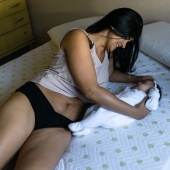
- Lying on the side with knees bent, let the tummy relax
- While breathing out, draw in the lower tummy, pulling the tummy button towards the spine
- Draw the pelvic floor up at the same time
- Hold for 10 seconds while breathing normally, then release
- Repeat up to 10 times
Stomach exercise on all fours (NHS, 2023 a)
- Start on all fours, with the knees under the hips and hands under the shoulders. The fingers face forward and the stomach muscles keep the back straight.
- Pull in the stomach muscles and curl the back towards the ceiling, forming an arch. Relax the head and neck. Keep the elbows straight but not locked.
- Hold this for a few seconds then return to the original position with a straight back.
- Do this rhythmically 10 times, making the muscles work hard and moving the back carefully. Some people find it helps to focus on breathing in time with the movement.
- Only move the back as much as feels comfortable.
Pelvic tilt exercises
These exercises can strengthen the stomach and pelvis (NHS, 2023 a):
- Stand with shoulders and bottom against a wall, keeping the knees soft.
- Pull the belly button towards the spine and flatten the back against the wall.
- Hold for 4 seconds and release.
- Repeat up to 10 times.
During pregnancy, it is common for the two muscles that run down the middle of the stomach to separate as the uterus pushes them apart. This is called diastasis recti [di-a-stay-sis rec-ti] or DRAM (diastasis rectus abodominus muscle) (NHS, 2023 b; POGP, no date d).
The stomach muscles usually go back to normal by about eight weeks after birth. If they haven’t, talk to the GP at the 6-8 week check or arrange a separate appointment (NHS, 2023 b).
To check the amount of separation between the stomach muscles (NHS, 2023 b):
- Lie on the back with legs bent and feet flat on the floor.
- Raise shoulders off the floor and look at the tummy.
- Feel between the edge of the muscles above and below the belly button. See how many fingers can fit between the gaps.
In the early days after birth, and if the muscles are separated, these tips can help to feel more comfortable (POGP, no date d; NHS, 2023 b):
- Practice pelvic floor and stomach exercises to reduce the separation
- When lying down, roll onto the side before pushing up to sitting. Avoid sitting straight up from lying.
- When lifting something (including the baby), keep the back straight and knees bent. Hold the weight close, and pull tummy muscles in towards the spine. Pull up on the pelvic floor. Breathe normally and lift.
- Avoid strenuous activities which require twisting, lifting or bending.
- Avoid sit-ups, crunches and the plank. Try walking or gentle core exercises such as yoga until stronger.
- Eat a varied diet to avoid constipation. Using a step or stool under the feet while on the toilet can help.
Further information
The professional network Pelvic Obstetric and Gynaecological Physiotherapy (POGP) has videos about pelvic health in different languages.
Hübner M, Rothe C, Plappert C, Baeßler K (2022) Aspects of Pelvic Floor Protection in Spontaneous Delivery – a Review. Geburtshilfe Frauenheilkd. 82(04): 400-409. https://doi.org/10.1055/a-1515-2622
NHS (2023 a) Exercise in pregnancy. https://www.nhs.uk/pregnancy/keeping-well/exercise/ [23 Dec 25]
NHS (2023 b) Your post-pregnancy body. https://www.nhs.uk/baby/support-and-services/your-post-pregnancy-body/ [23 Dec 25]
POGP (no date c) Pelvic floor muscles. https://thepogp.co.uk/patients/pelvic_health_advice/pelvic_floor_muscle… [23 Dec 25]
POGP (no date a) Perineal Healing After Having Vaginal Birth. https://thepogp.co.uk/patient_information/pregnancy_and_early_postnatal… [23 Dec 25]
POGP (no date b) Recovery after having a caesarean section. https://thepogp.co.uk/patient_information/pregnancy_and_early_postnatal… [23 Dec 25]
POGP (no date d) Tummy muscle separation (DRAM) in pregnancy. https://thepogp.co.uk/patient_information/womens_health/tummy_muscle_se… [23 Dec 25]