What is a low-lying placenta?
When the placenta attaches low inside the uterus and near to the cervix, it’s called a low-lying placenta (LLP). This is checked for at the routine 20-week ultrasound (RCOG, 2018).
As the uterus grows upwards, the placenta may no longer be close to the cervix. This will be checked during an extra scan at 32 weeks. A transvaginal scan may be offered. This is where a probe is placed inside the vagina to check exactly where the placenta is lying. This is safe for the mother or birthing parent and baby (RCOG, 2018).
Only 1 in 10 women who have a low-lying placenta at 20 weeks will still have LLP at 32 weeks. This means 9 out of 10 will not (RCOG, 2018).
If the 32-week scan finds that the placenta is still low-lying, the mother or birthing person will be offered another scan at 36 weeks. If the placenta is then found to be 2cm or more from the inside of the cervix, then it is possible to plan for a vaginal birth (RCOG, 2018).
A pregnant woman or person who knows they have a low-lying placenta should contact their midwife, GP or hospital maternity unit immediately if any of the following occur (RCOG, 2018):
- Vaginal bleeding
- Contractions
- Pain
Placenta praevia
If the placenta is covering all or part of the cervix, it is called placenta praevia or previa [pree-vee-uh]. It happens in around one in 200 pregnancies (NHS, 2026; RCOG, 2018).
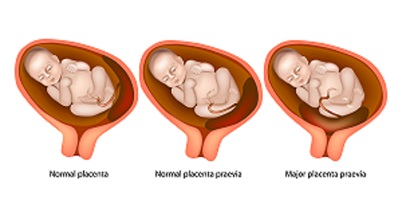
When the placenta is partially or totally covering the cervix, a caesarean birth will be recommended (NHS, 2026; RCOG, 2018).
What are the risks of placenta praevia?
As the lower part of the uterus stretches in late pregnancy the connection between the placenta and the uterus can be under strain. This means a higher chance of vaginal bleeding. The bleeding is usually painless, with bright red blood. It can be very heavy and, in some cases means that both the parent and baby are at risk of excessive bleeding (NHS, 2026; RCOG, 2018).
Women and birthing people with placenta praevia have a high chance of giving birth before 37 weeks (RCOG, 2018).
Caesarean birth will be recommended because the contractions of a vaginal birth will lead to the placenta detaching from the uterus. This could mean life-threatening bleeding for mother or birthing person and baby (RCOG, 2018).
What else might suggest placenta praevia?
Any vaginal bleeding in the second half of pregnancy might be a sign of placenta praevia. The bleeding isn’t usually painful and may be noticed after sex (RCOG, 2018).
If the baby is in an unusual position, such as bottom first (breech) or lying across the womb (transverse), then the position of the placenta will be checked in case that is the reason (RCOG, 2018).
What extra antenatal care is offered with placenta praevia?
As well as the additional scans offered to confirm placenta praevia, additional care or medication may be needed (RCOG, 2018).
Women and birthing people with placenta praevia need to avoid anaemia (low levels of red blood cells). They will be advised to have a healthy diet and may be offered an iron supplement. Their blood may be checked regularly for anaemia (RCOG, 2018). Take a look at our article on Eating in pregnancy and after birth.
If bleeding happens during pregnancy, the doctor may ask to examine inside the vagina to see how much blood has been lost and where it is coming from (RCOG, 2018).
A mother or birthing person may be offered a course of steroid injections between 34 and 36 weeks to protect the baby in case they are born early. If labour does start early, medication to stop the contractions may be offered to allow the steroids to be given (RCOG, 2018).
Planning for birth with placenta praevia
The healthcare team will discuss options with the mother or birthing person if they feel that it may be safer for the baby to be born by caesarean (RCOG, 2018).
A caesarean birth for placenta praevia is usually be planned for between 36 and 37 weeks. If there has been heavy or frequent vaginal bleeding during the pregnancy, it may need to take place earlier (RCOG, 2018).
During the birth, there might be more bleeding than would normally happen. In severe cases, a blood transfusion may be required.
If the woman or birthing person knows that they would not accept a blood transfusion, they should let the maternity team know as early as possible in the pregnancy so that options can be discussed (RCOG, 2018).
The medical team will do their best to stop the bleeding. If that is not possible then it may be necessary to remove the uterus to save the mother or birthing person’s life (RCOG, 2018).
What are the causes of placenta praevia?
The chance of having a placenta praevia is higher if the mother or birthing person (RCOG, 2018):
- Had a previous caesarean birth
- Had treatment for infertility
- Smokes
NHS (2026) What complications can affect the placenta? https://www.nhs.uk/pregnancy/labour-and-birth/placenta-complications/ [9 Jun 26]
RCOG. (2018) Placenta praevia, placenta accreta and vasa praevia. https://www.rcog.org.uk/for-the-public/browse-our-patient-information/p… [9 Jun 26]