
Remifentanil is a quick-acting opioid. Women and birthing people can use it to manage their pain during labour. Find out how it is different from other opioids used in labour and childbirth.
What are opioids?
Opioids [o-pee-oydz] are a range of pain medicines that can be used during labour. Pethidine [peh-thi-deen] and diamorphine [dye-uh-mor-feen] are other opioids that are also used.
However, while pethidine and diamorphine are given by a single injection into a muscle, remifentanil [rem-ee-fen-tan-ill] is given by a drip into a vein. Once set up, the drip can be controlled by the woman or birthing person themselves (LabourPains, no date a).
This method of pain management is called a Patient-controlled Analgesia (PCA) or Patient-Controlled Intravenous Analgesia (PCIA) (Labour Pains, no date a). Analgesia [ann-al-jeez-ee-ah] is another word for a drug used to manage pain.
How does remifentanil work?
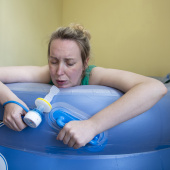
Remifentanil enters the bloodstream via a drip which goes into a vein in the hand. The woman or birthing person holds a button and presses it when they want the pain relief. This delivers a small amount into the vein (LabourPains, no date a).
The woman or birthing person can control how much is given (LabourPains, no date a). They can’t give themselves too much, as the drip machine prevents overdosing.
It works more quickly than other opioids used in labour. It also wears off more quickly than other opioids (LabourPains, no date a).
Some women and birthing people appreciate that remifentanil is short-acting, which meant it wears off quickly if they do not like the effect (Moran et al, 2019).
Why might someone have remifentanil?
Remifentanil may be an alternative for someone who cannot have an epidural because of (Avila Hernandez & Hendrix, 2025):
- Personal choice
- Infection at the site that the epidural would be inserted
- Low platelets or other blood clotting concerns
- Unique anatomy, or damage to the spine
Or it might be given because the mother or birthing person would prefer it to an epidural (LabourPains, no date a).
How effective is remifentanil?
Many women and birthing people have found remifentanil effective for pain relief during labour (Moran et al, 2019). It is considered more effective for pain management than pethidine or diamorphine, but less effective than an epidural (Weibel et al, 2017).
However, fewer women or birthing people went on to have an epidural after taking remifentanil when compared to pethidine (Wilson et al, 2018).
Trials have compared remifentanil with other opioid pain relief or epidural. They have not considered other ways of managing pain. This makes it impossible to compare outcomes with labours that do not use opioids or epidural (Weibel et al, 2017).
Are there any side effects of remifentanil?
A benefit is that remifentanil provides effective pain relief while the woman or birthing person remains alert and focused (Moran et al, 2019). However, while taking remifentanil, it can make the mother or birthing person feel (NHS, 2023; Moran et al, 2019):
- Sick (although the sickness is usually less than when using pethidine)
- Dizzy
- Itchy
These feelings should go away after stopping (NHS, 2023).
Some women and birthing people may feel (Moran et al, 2019; NHS, 2023):
- Breathless (a clip on a finger measures oxygen levels, and a few people need oxygen)
- Distanced from the experience (more so than when using pethidine)
- Anxious about the drip running out
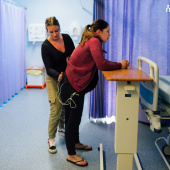
- Restricted in their movements by the remifentanil drip
- Some effects on memory of the labour and birth
There is no increased chance of having a caesarean birth when compared with epidural (Weibel et al, 2017).
Are there any side effects on the baby or breastfeeding?
Remifentanil doesn’t usually pass to the baby in high enough amounts to significantly affect them (Mitchell et al, 2020). Like pethidine, it may affect the baby’s breathing at birth but this usually wears off quickly (NHS, 2023).
The five-minute Apgar score for the baby is not affected when the mother or birthing person has used remifentanil (Weibel et al, 2017).
Remifentanil has a similar effect to pethidine on breastfeeding. That is, it can make the mother or birthing person, or baby, more sleepy immediately after birth (Moran et al, 2019).
Will I be able to have remifentanil?
An anaesthetist must give remifentanil on an obstetric ward. It is less commonly used than other drugs in childbirth, and may not be available (Labour Pains, no date a; Wilson et al, 2018).
If it is not available, the anaesthetist will discuss other forms of pain management.
What other pain management options are available?
To learn about other pain management options read our article on Pain management in labour.
Avila Hernandez AN, Hendrix JM. (2025) Epidural Anesthesia. In: StatPearls. Treasure Island (FL): StatPearls Publishing; Jan-. https://www.ncbi.nlm.nih.gov/books/NBK542219/ [5 Jan 26]
LabourPains (no date a) Patient-controlled intravenous analgesia. https://www.labourpains.org/during-labour/patient-controlled-intravenou… [5 Jan 26]
LabourPains (no date b) Pain relief in labour: How do the different options compare? https://www.labourpains.org/during-labour/pain-relief-comparisons?optio… - compare [5 Jan 26]
Mitchell, J., Jones, W., Winkley, E. and Kinsella, S.M. (2020), Guideline on anaesthesia and sedation in breastfeeding women 2020. Anaesthesia, 75: 1482-1493. https://doi.org/10.1111/anae.15179
Moran VH, Thomson G, Cook J, et al (2019) Qualitative exploration of women’s experiences of intramuscular pethidine or remifentanil patient-controlled analgesia for labour pain. BMJ Open; 9:e032203. https://doi.org/10.1136/bmjopen-2019-032203
NHS (2023) Pain relief in labour. https://www.nhs.uk/pregnancy/labour-and-birth/pain-relief-in-labour/ [5 Jan 26]
Weibel S, Jelting Y, Afshari A, Pace NL, Eberhart LHJ, Jokinen J, Artmann T, Kranke P. (2017) Patient‐controlled analgesia with remifentanil versus alternative parenteral methods for pain management in labour. Cochrane Database of Systematic Reviews, Issue 4. Art. No.: CD011989. https://doi.org/10.1002/14651858.CD011989.pub2
Wilson MJA, MacArthur C, Hewitt CA, Handley K, Gao F, Beeson L, et al. (2018) Intravenous remifentanil patient-controlled analgesia versus intramuscular pethidine for pain relief in labour (RESPITE): an open-label, multicentre, randomised controlled trial. Lancet. 392(10148):662-672. https://doi.org/10.1016/S0140-6736(18)31613-1